

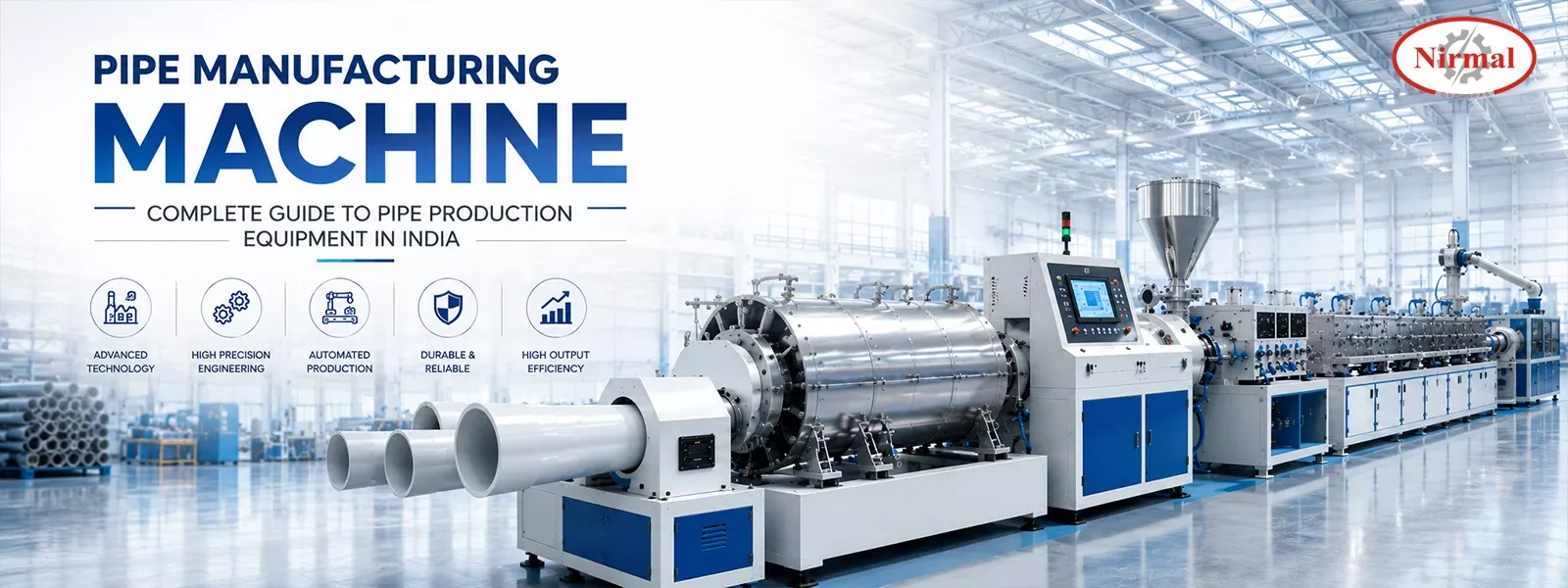
Quick Answer: What Is a Pipe Manufacturing Machine?
A pipe manufacturing machine — also called a pipe making machine or pipe mill — is industrial equipment that forms flat steel strips or coils into round, square, or rectangular hollow sections through a continuous rolling and welding process. These machines are the backbone of tube and pipe production lines used across construction, infrastructure, oil and gas, agriculture, and fabrication industries in India and globally.
Key Takeaways
- Pipe making machines convert steel coils into finished pipes through a sequence of forming, welding, sizing, and cutting stages.
- Two primary machine categories exist: tube mills (for precision thin-wall sections) and pipe mills (for thicker, structural or pressure-rated pipe).
- Automatic high-frequency induction welding (HFI/ERW) has become the dominant joining technology in modern Indian pipe manufacturing lines.
- Capital costs for a pipe machine in India typically range from lakhs to crores (contact for pricing) depending on production capacity, automation level, and pipe diameter range.
- Choosing a reliable pipe machine manufacturer in India requires evaluating after-sales support, spare parts availability, and alignment with BIS/IS standards.
- Production speed, diameter range, and wall thickness capacity are the three most critical selection parameters for any pipe manufacturing line.
- India has emerged as a significant hub for pipe machine manufacturers, offering competitive pricing without sacrificing engineering quality.
Introduction: Why Pipe Production Equipment Matters
Walk through any major infrastructure project in India — a metro rail station, an industrial park, a housing complex, or an irrigation canal — and you will find pipes everywhere. Structural hollow sections in columns, ERW pipes in plumbing, precision tubes in handrails, and heavy-wall pipes in underground utilities. All of these originate from one place: a pipe manufacturing machine.
Yet most project stakeholders — contractors, procurement managers, site engineers — focus entirely on the finished pipe specification and rarely consider how that pipe was made. Understanding the pipe making machine behind the product helps you evaluate supplier quality, set realistic lead time expectations, and make smarter procurement decisions.
This guide covers everything from how a pipe machine works mechanically, to the types of manufacturing lines available, to what buyers and investors in India need to know before committing to a pipe manufacturing setup.
How Does a Pipe Making Machine Work?
The pipe manufacturing process — regardless of machine brand or scale — follows the same fundamental sequence.
Stage 1: Decoiling and Leveling
A coil of hot-rolled or cold-rolled steel strip (the raw material) is loaded onto a decoiler. The strip is fed through a straightening/leveling unit to remove the coil’s natural curvature before forming begins.
Stage 2: Edge Milling or Trimming
The strip edges are trimmed to an exact width and sometimes beveled to ensure clean, consistent weld seams downstream.
Stage 3: Forming Rolls
This is the heart of the pipe machine. A series of forming roll stands progressively bend the flat strip into an open tube shape. Each roll stand applies a calculated deformation — early stands create the general curve, middle stands refine the radius, and the final forming stands bring the two edges together into an open seam configuration.
The number of roll stands varies: smaller machines may use 6–8 stands; larger, high-speed lines can use 12 or more.
Stage 4: High-Frequency Welding (HFI/ERW)
The open seam passes through a high-frequency induction coil or contact welding station. HFI (High-Frequency Induction) welding heats the strip edges to near-melting point. Squeeze rolls then press the edges together, forging a solid-state weld without filler material.
This is the fastest, cleanest welding method available for continuous pipe production, and it’s what separates modern electric resistance welded (ERW) pipe from older submerged arc or manual processes.
Stage 5: Scarfing or Bead Removal
The internal and external weld bead (excess material) is removed by a scarfing tool to ensure the pipe’s inner bore is smooth and meets dimensional tolerances.
Stage 6: Sizing and Straightening
The welded tube passes through a sizing mill — a set of roll stands that bring the pipe to its exact final OD (outer diameter) and roundness spec. A straightener follows to eliminate any bow introduced during the process.
Stage 7: Cutting to Length
A flying cut-off saw or disc cutter cuts the continuous pipe to the specified length without stopping the mill — hence “flying.” Lengths are typically 6 m or 12 m for standard commercial production.
Stage 8: End Finishing and Inspection
Cut pipes proceed to end-facing, chamfering, hydrostatic testing (for pressure-rated grades), ultrasonic inspection, and marking before bundling and dispatch.
Types of Pipe Manufacturing Lines
Not all pipe making machines are the same. The right line depends on your product range, production volume, and end market.
ERW Pipe Mill (Electric Resistance Welded)
The most common pipe manufacturing line in India. Uses HFI welding. Produces pipes from ½” to 24″+ OD with wall thicknesses from 1.5 mm to 20 mm+. Used for structural, plumbing, construction, and general engineering applications.
Best for: MS (mild steel) structural hollow sections, scaffolding pipes, plumbing pipes, agriculture pipes.
Precision Tube Mill
Designed for tighter tolerances and thinner walls than a standard pipe mill. Typically operates at higher speeds and produces smaller-diameter tubes (6 mm to 100 mm OD) used in automotive, furniture, bicycle frames, and precision engineering.
Best for: Automotive components, furniture tubes, hydraulic tubing, aerospace-grade sections.
Spiral Pipe Mill
Uses a helical forming process to create large-diameter pipes (400 mm to 3,000 mm+) from wider coil stock. Predominantly used for water transmission mains, oil and gas pipelines, and piling applications.
Best for: Large-diameter infrastructure pipes, piling, water mains.
Square and Rectangular Hollow Section (SHS/RHS) Line
An ERW pipe mill fitted with a dedicated section-forming unit after the circular sizing mill. The round tube is reformed into square or rectangular profiles used extensively in structural fabrication and construction frames.
Best for: Structural hollow sections for construction, fabrication, and industrial frames.
Machine Type | Diameter Range | Wall Thickness | Key Application |
ERW Pipe Mill | 15 mm – 600 mm | 1.5 – 20 mm | API Tube Mill, structural, ASTM Grid CDW Tube, Oil & Gas, Automobile |
Precision Tube Mill | 6 mm – 100 mm | 0.5 – 5 mm | Automotive, furniture, precision parts |
Spiral Pipe Mill | 400 mm – 3,000 mm | 6 – 25 mm | Water line, sewage line, oil & gas |
SHS/RHS Line | 20 mm – 400 mm | 1.5 – 12 mm | Infra structure, construction sheds, Industrial & infra sheds |
Tube Mill vs Pipe Mill: What’s the Difference?
This distinction confuses many buyers and procurement teams.
In engineering usage, a tube is judged primarily by its dimensional precision — outer diameter, inner diameter, wall thickness, and straightness tolerance. Tubes are used in applications where fit matters: hydraulic cylinders, heat exchangers, precision assemblies.
A pipe is judged primarily by its pressure-carrying capacity and is specified by a nominal bore (NB) size with a schedule (wall thickness class). Pipes carry fluids, gases, or structural loads in less demanding dimensional contexts.
In equipment terms:
- A tube mill prioritizes dimensional accuracy, surface finish, and tight tolerances. It typically runs at higher speed with closer roll calibration and more post-weld processing steps.
- A pipe mill prioritizes output volume, wall thickness range, and weld integrity for structural and pressure service.
In India, many manufacturers use the terms interchangeably for commercial purposes, so always clarify by specifying the product standard (IS 1239, IS 3589, IS 4270, ASTM A53, API 5L, etc.) when sourcing equipment.
Cost of Pipe Manufacturing Machines in India
Capital cost is naturally one of the first questions from any investor or manufacturer upgrading their production. The range is wide.
Entry-Level Lines (contact for pricing)
Small-diameter ERW mills (½” to 2″ OD), manual or semi-automatic, suited for job shops, small structural tube producers, and secondary processors. Production speeds of 20–40 m/min. Typically Chinese or Indian-assembled machines.
Mid-Range Production Lines (contact for pricing)
Medium-diameter mills (up to 6″ OD), with fully automatic PLC controls, integrated HFI welding, flying cut-off, and online quality monitoring. Production speeds of 40–80 m/min. The core of India’s domestic structural tube industry.
High-Capacity / Precision Lines (contact for pricing)
Large-diameter or high-precision lines with servo-controlled forming, ultrasonic weld inspection, automatic bundling, and advanced tooling management. Used by large integrated manufacturers, export-grade producers, or API-certified pipe mills.
Ongoing cost factors to budget for:
- Roll tooling replacement (every 800–3,000 MT of production depending on material)
- HFI welding coil and contact maintenance
- Flying saw blade consumption
- Preventive maintenance contracts
- Operator training and certification
Choosing a Pipe Machine Manufacturer in India
India has a well-developed ecosystem of pipe machine manufacturers concentrated in Gujarat (Ahmedabad, Rajkot), Maharashtra (Pune, Mumbai), and Tamil Nadu (Coimbatore, Chennai). The quality gap between suppliers is meaningful.
What Separates Good Manufacturers from Average Ones?
- In-house machining capability – The best pipe machine manufacturer in India designs and machines their own roll forming stands and tooling rather than assembling from bought-out components. This matters enormously for precision and long-term spare parts availability.
- Application engineering support – A reputable pipe making machine manufacturer in India will send technical teams to your site during installation, conduct test runs with actual coil material, and optimize roll passes for your specific product mix — not just commission the machine and leave.
- After-sales and spare parts commitment – Downtime on a pipe mill is extremely expensive. Confirm spare parts availability, lead times, and whether the manufacturer stocks critical wear parts locally.
- Compliance with standards – Quality pipe manufacturing equipment should support production of pipes meeting BIS standards (IS 1239, IS 3589, IS 4923 for hollow sections), and for export-grade producers, API, ASTM, or EN standards.
- Reference plant visits – Any credible pipe machine manufacturer in India will facilitate visits to existing customer installations. Insist on this. A working installation tells you more than a brochure ever will.
Red Flags When Evaluating Pipe Machine Manufacturers
- Unusually low prices with vague specifications
- No clear production speed or tolerance data in technical proposals
- Inability to provide customer references in your diameter range
- Generic “copy” designs with no proprietary engineering
- No clear documentation on tooling change times (which affects production flexibility)
Industry Standards and Quality Benchmarks
Quality in pipe production is governed by product standards, but the machine itself must be capable of consistently meeting those standards across production runs.
Key Indian Standards for structural and pressure pipes:
- IS 1239 (Part 1 & 2) — Steel tubes for structural purposes
- IS 3589 — Steel pipes for water and sewage
- IS 4923 — Hollow steel sections for structural use
- IS 9295 — Steel tubes for idler rollers
International references applicable to Indian export producers:
- API 5L — Line pipe for oil and gas transmission
- ASTM A53/A106 — Carbon steel pipes
- EN 10219 / EN 10210 — Cold-formed and hot-formed structural hollow sections
A pipe machine manufacturer in India supplying equipment to export-focused producers must demonstrate that the line can meet these tolerances — particularly on OD, wall thickness variation, and straightness — under continuous production conditions.
Pipe Manufacturing Machines and Real-World Project Applications
At companies like Nirmal Overseas Private Limited, which executes turnkey industrial and infrastructure projects, the connection between production equipment quality and project outcomes is direct.
Structural hollow sections used in industrial buildings, mezzanine platforms, pipe racks, and equipment supports all begin as strip steel processed through a pipe manufacturing machine. The dimensional consistency of that pipe — straightness, OD tolerance, wall thickness uniformity — directly affects fabrication speed, weld quality, and structural performance on site.
Site engineers and structural consultants working on industrial facilities often specify tight tolerances on hollow sections for pre-engineered buildings (PEBs) or modular construction. These specifications can only be consistently met when the pipe making machine upstream is properly calibrated and maintained.
For contractors executing EPC or turnkey projects where delivery schedules are tight, understanding your pipe supplier’s production equipment — and whether it’s fit for purpose — is as important as reviewing the mill test certificate.
Current Trends in Pipe Manufacturing Equipment
- Automation and Industry 4.0 integration – Modern pipe machines increasingly feature PLC-based closed-loop control, real-time thickness monitoring via laser gauges, and automated defect detection. This reduces operator dependency and improves consistency — a major priority for Indian manufacturers targeting export markets.
- Energy efficiency – Solid-state HFI welding power supplies (IGBT-based inverters) have largely replaced older vacuum tube systems, reducing energy consumption by 15–25% for equivalent welding output.
- Quick-change tooling systems – Product changeover time — the time to switch from one pipe diameter to another — is a competitive differentiator. Leading pipe machine manufacturers in India now offer modular roll cartridge systems that allow diameter changes in 2–4 hours versus 8–12 hours on older designs.
- Online ultrasonic testing integration – For API-grade and pressure-service pipe lines, inline UT (ultrasonic testing) has moved from a downstream inspection step to an integrated online station, improving defect detection rates without reducing production speed.
FAQs
What is a pipe manufacturing machine?
It is a production line that continuously converts flat steel strip into finished welded pipe or tube through sequential forming, welding, sizing, and cutting operations.
How does a pipe making machine work?
A steel coil feeds into forming roll stands that progressively shape it into an open seam tube. High-frequency welding fuses the seam, sizing rolls set the final diameter, and a flying cutter produces pipes of the required length.
What is the difference between a pipe mill and a tube mill?
A pipe mill focuses on wall thickness range and volume output for structural/pressure pipe. A tube mill prioritizes dimensional precision and surface finish for applications where tight tolerances are critical.
What types of pipes can be made on an ERW pipe machine?
MS structural pipes, plumbing pipes (IS 1239), water transmission pipes (IS 3589), square/rectangular hollow sections (IS 4923), and API 5L line pipe are all produced on ERW machines depending on configuration.
How much does a pipe manufacturing machine cost in India?
Entry-level lines start around (contact for pricing) lakh. Mid-range automated mills cost (contact for pricing). High-capacity or precision lines can exceed ₹5–10 crore depending on diameter range and automation level.
Who are the leading pipe machine manufacturers in India?
India has reputable pipe making machine manufacturers concentrated in Gujarat, Maharashtra, and Tamil Nadu. Buyers should evaluate on-site machining capability, standards compliance, reference installations, and after-sales support rather than price alone.
What raw material is used in a pipe manufacturing machine?
Hot-rolled steel coils (HR coils) are the primary input for structural ERW pipe. Cold-rolled coils (CR coils) are used for precision tubes requiring better surface finish and tighter tolerances.
What is HFI welding in a pipe mill?
HFI (High-Frequency Induction) welding uses electromagnetic induction to heat the strip edges to forging temperature. Squeeze rolls forge the edges together, creating a weld without filler metal. It is the fastest and most energy-efficient welding method for continuous pipe production.
What standards should Indian pipe machines comply with?
Machines supplying domestic markets should support IS 1239, IS 3589, and IS 4923 production. Export-grade lines additionally require capability for API 5L, ASTM A53, or EN 10219 compliance.
Is a pipe making machine suitable for small-scale production?
Yes. Entry-level ERW mills are designed for small-to-medium producers and job shops. However, minimum viable production economics typically require a production volume of at least 2,000–3,000 MT per year to justify capital and operating costs.
What maintenance does a pipe manufacturing machine require?
Regular maintenance includes roll tooling inspection and replacement, HFI welding coil servicing, flying saw blade replacement, gearbox and bearing lubrication, and alignment checks after tooling changes.
How long does it take to install a pipe making machine?
A standard ERW mill typically takes 4–8 weeks from equipment delivery to first production, including civil works, electrical commissioning, and trial runs. Complex large-diameter lines may take 3–6 months.
What is the production speed of a typical pipe manufacturing line?
Standard ERW mills run at 30–80 m/min. High-speed precision tube mills can exceed 120 m/min. Actual throughput depends on diameter, wall thickness, and tooling condition.
Can a single pipe machine produce multiple diameters?
Yes. Most ERW mills are designed for a diameter range (e.g., 20 mm to 165 mm) with roll tooling changes between product runs. Quick-change tooling systems reduce changeover time significantly.
What is the energy consumption of a pipe manufacturing machine?
A mid-range ERW mill with HFI welding typically consumes 150–400 kW depending on mill size and production speed. Modern IGBT-based HFI power supplies are significantly more efficient than older systems.
Conclusion
The pipe making machine is where raw steel coil becomes the structural and functional pipe that India’s construction and industrial sectors depend on. Understanding how these machines work — the forming sequence, welding technology, sizing process, and cutting system — gives procurement professionals, project managers, and investors a meaningful advantage when evaluating supplier quality or investing in production capacity.
For organizations involved in steel processing, structural fabrication, or turnkey project execution, the quality of the pipe manufacturing equipment upstream is never a trivial detail. It shows up in dimensional consistency, weld integrity, production lead times, and ultimately in project outcomes.
Whether you are sourcing finished pipe for a project or evaluating a pipe machine manufacturer in India for a new production line, the fundamentals covered in this guide provide a practical framework for smarter decision-making.
Nirmal Overseas Private Limited specializes in turnkey industrial projects and steel processing solutions. For more information on our project capabilities, visit – nirmaloverseas.com/turnkey-projects.