
API Pipe Mill Manufacturer in India: API Tube Mills for Pipe Making and Straightening
OUR OFFICES
KHASRA NO – 134/9/2, VILLAGE-BARHANA TEHSIL-BERI, JHAJJAR HARYANA – 124107
nirmal@nirmaloverseas.com
info@nirmaloverseas.com
+91-9817975382 / 79
OUR BROCHURE


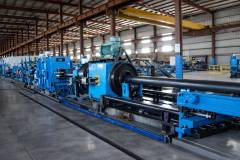
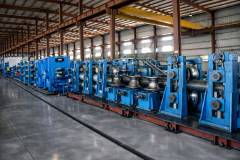
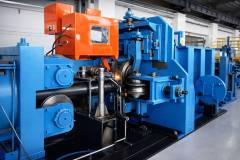
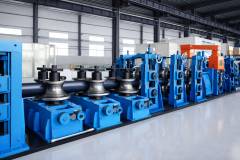
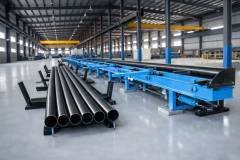
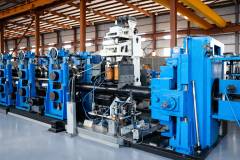


An API pipe mill is the production line that turns HR coil into API 5L line pipe: forming, high-frequency welding, sizing, cutting and testing. Nirmal Overseas is an API pipe mill manufacturer in India and an API tube mill manufacturer in India. We build lines for 2″ to 24″ NB pipe in grades X52 to X70 at our plant in Jhajjar, Haryana.
Below you get configurations, specifications, a buyer checklist and the mistakes we see most often. Already know your pipe sizes? Jump to the enquiry section.
What Is an API Pipe Mill (API Tube Mill)?
An API pipe mill is a continuous ERW/HFW production line that forms HR coil into a round pipe, welds the seam with high-frequency current, then sizes, cuts and tests it so the finished line pipe can meet API 5L. The mill makes the pipe. The pipe manufacturer, not the machine, holds the API licence.
“API pipe mill” and “API tube mill” mean the same thing in the trade. An ordinary tube mill built for furniture or structural tubes is a different machine. It usually has lighter drives, looser weld control and no seam heat treatment or full testing.
A machine is not “API certified.” Compliance belongs to the pipe plant, normally through an API Q1 and Monogram licence. What we supply is a mill with the forming accuracy, weld control and testing stations that make compliance achievable.
API 5L Line Pipe: PSL1, PSL2 and Grades
API 5L covers seamless and welded line pipe for oil, gas and water pipelines, and it is aligned with ISO 3183. PSL1 is standard quality. PSL2 adds stricter chemistry, mechanical property and testing requirements.
The number after “X” is minimum yield strength in thousands of psi, so X60 means 60,000 psi. Our mills are set up for X52, X56, X60, X65 and X70. The higher the grade, and the moment you move to PSL2, the tighter your weld control, seam heat treatment and inspection need to be.
API Pipe Mill Types and Configurations by Pipe Size
You pick a mill by diameter and wall thickness first, then by welding process.
Configuration | NB range | Typical use | What to expect |
Small-bore | 2″ to 6″ | Water and gas distribution | Lighter coil handling, quicker roll changes |
Mid-range | 6″ to 12″ | Transmission and distribution lines | Balanced drive size and floor space |
Large-bore | 12″ to 24″ | Trunk lines, large water mains | Heavier coil, bigger drives, more space |
ERW vs HFW: Modern API line pipe uses HFW, the high-frequency electric resistance weld. Spiral submerged-arc (HSAW) is a different machine for larger diameters and is not covered here.
Take a buyer starting a new 4″ to 8″ line pipe unit. One mid-range mill usually fits, with the seam normalizer and hydro tester added first and other equipment later. If you are upgrading an old tube mill, the weld power supply and the testing end are usually the weak points. Our high speed tube mill page covers lighter sizes.
How an API Pipe Mill Works: Process and Weld Defects
- Uncoiling and joining: HR coil (skelp) is joined, and an accumulator keeps the line running during coil changes. The wide coil goes through a slitting line first.
- Forming: breakdown and fin-pass stands shape the strip and bring the edges together.
- HF welding: a solid state HF tube welder heats the edges and squeeze rolls forge the seam.
- Bead trimming: inside and outside weld flash is removed.
- Seam annealing: a seam normalizer for API pipe restores the weld zone structure. PSL2 pipe needs it.
- Sizing: sizing stands and a turk’s head set final diameter and shape.
- Flying cut-off: pipe is cut to length while the line keeps moving.
- Finishing and testing: straightening, end facing, bevelling, NDT such as ultrasonic or eddy current testing, and hydrostatic testing.
Common weld defects and fixes
- Cold weld: too little heat or a wrong vee angle. Check power, line speed and vee geometry.
- Hook crack: inclusions or poor strip edges. Check coil quality and edge condition.
- Seam offset: uneven edges or squeeze roll setting. Re-set fin-pass and squeeze rolls.
On most lines, weld trouble starts before the welder, in the coil edges and the forming set-up. Check those first.
Yield loss comes from start-up pipe, end-of-coil crop and test rejects. Log them by shift and you will see where the losses really are.
Steel Pipe Making Machine: How the Complete Pipe Line Works?
A steel pipe making machine is a complete line, not a single unit. The entry end has the uncoiler, joiner and accumulator. The mill has forming, welding and sizing. The exit has the flying cut-off and run-out table. An API plant adds seam normalizing, straightening, end finishing, NDT and hydro testing.
Material should flow one way: coil storage, slitting, mill, finishing bay, hydro tester, dispatch. Plan the bay for the whole flow, not just the mill. As a steel pipe making machine manufacturer in India, we have seen buyers buy the mill and then find no room for the test equipment.
Before you order, work out your power supply, floor space, cooling water, crane capacity and how often you will change sizes. Frequent size changes cost more output than a slightly slower line speed. Our turnkey projects cover the line and its layout together.
Pipe Straightening Machine for API Pipe: Role, Types and Quality Impact
Cutting, cooling and seam heat treatment all add bow to the pipe. A pipe straightening machine removes it. As a pipe straightening machine manufacturer in India, we build these units to run offline or as part of a full API line.
Why it matters: API 5L limits straightness. The usual figure is a total deviation of 0.2% of pipe length, plus a tighter limit near the ends. Check the edition you work on. Crooked pipe causes poor fit-up in field welding, jams in coating lines and uneven bevels at the ends. Roll straighteners can also help ovality when set correctly. Set too hard on thin walls, they make it worse.
Types
- Two-roll rotary straightener: the usual choice for line pipe.
- Multi-roll straightener: common for lighter tubes.
- Press straightener: fixes bent ends or single bends, but slower.
Where it sits: after the flying cut-off, before end facing and final inspection.
Limit: it cannot fix heavy twist or residual stress from poor coil or forming. Fix the cause at the mill. We also build standalone straighteners that run offline.
API Pipe Mill Technical Specifications
Parameter | Specification |
API grades | API 5L X52, X56, X60, X65, X70 |
Pipe size | 2″ to 24″ NB |
Wall thickness | 4 mm to 10.5 mm |
Line speed | 12 to 60 m/min |
Automation | Fully automatic |
Weld process | HFW with solid state HF welder |
Testing | Hydro testing for API pipe available |
Limits depend on configuration and coil quality. Confirm your size, thickness and grade combination before you order.
Applications of API Pipe Mills by Industry
- Oil and gas: gathering and transmission lines for crude oil and natural gas.
- Water transport: intake, distribution and long-distance mains.
- Construction and infrastructure: structural and piling pipe where line pipe grades are specified.
What this mill does not make: casing and tubing follow API 5CT, which adds heat treatment and threading. Seamless pipe needs a different process. Tell us your product list at the start, so we can say plainly what fits.
How to Choose an API Pipe Mill Manufacturer?
- Can you visit a working line making similar sizes?
- Are size, thickness and grade range written in the quotation?
- Which HF welder is used, and what is its rating?
- Is the seam normalizer included?
- What NDT and hydro testing options are included?
- How long is a roll changeover, and how many roll sets are supplied?
- Is a pipe straightening machine part of the offer?
- What spares are stocked, and how fast is service?
- Who handles installation, trial runs and operator training?
- What are the power, water and floor space needs?
Get the answers in writing. A clear reply on tooling and testing tells you more than a brochure.
Common Mistakes When Buying an API Pipe Mill
- Buying the mill without planning the test end.
- Assuming the machine makes your pipe API compliant.
- Ignoring coil quality. A mill cannot fix bad chemistry or rough edges.
- Comparing only machine price, not tooling, spares and service.
- Skipping the changeover question when your sizes change often.
- Underestimating space and utilities.
Why choose Nirmal Overseas, an API Pipe Mill Manufacturer in India?
Our plant is at Khasra No. 134/9/2, Village Barhana, Tehsil Beri, Jhajjar, Haryana. We have exhibited at international fairs, including Messe Düsseldorf in Germany and Steelfab in Sharjah, listed on our events page. Certificates and awards are on our about us page.
As an API tube mill manufacturer in India, we supply the whole line, not only the mill. That includes slitting, seam normalizing, a pipe straightening machine and hydro testing for API pipe. Dealing with one supplier means one team answers for how the line works together.
What you get:
- Mills built for your size and thickness range
- Lines tuned for tight tolerances on diameter and wall
- Installation, training and maintenance support
- Completed projects you can review on our turnkey page
API Pipe Mill Installation, Training and After-Sales Support
We supervise erection, alignment, trial runs and first production. You prepare the foundation, power, cooling water and a crane before dispatch. Operators learn roll set-up, welder tuning and defect checks on their own line. We also supply wear parts and electricals after commissioning.
Basic maintenance
- Daily: lubrication and cooling water checks.
- Weekly: roll surfaces and drive checks.
- Monthly: bearings and welder coil inspection.
- Yearly: alignment check and roll regrind or replacement.
Follow the manual supplied with your line for actual intervals.
FAQs
How do I calculate the HR coil strip width for a given pipe size?
Strip width is roughly π × (outer diameter − wall thickness), plus a small trim allowance for edge milling. For a 168.3 mm OD pipe with 6 mm wall, that is about 510 mm before allowance. Your slitting setup and edge condition decide the final width.
What is the difference between seam annealing and full body normalizing?
Seam annealing heats only the weld zone after welding to refine its structure and relieve stress. Full body normalizing heats the whole pipe in a furnace. Most HFW line pipe lines use inline seam heat treatment. Check your API 5L edition and grade, because requirements differ between PSL1 and PSL2.
If I hydro test every pipe, do I still need ultrasonic or eddy current testing?
Yes. A hydrostatic test proves the pipe holds pressure, but it can miss small weld flaws that do not leak. Ultrasonic or eddy current testing checks the seam along its length. API 5L treats them as separate checks, so plan both stations and confirm scope for your PSL level.
What changes on the mill when I move from X52 to X70 pipe?
Higher yield strength means harder strips, more springback and higher forming loads. Roll settings, weld heat input and seam heat treatment all need re-tuning, and the wall thickness a mill can run may drop. Confirm each grade and thickness combination with your API pipe mill manufacturer in India.
Can one steel pipe making machine make both API and non-API pipe?
Yes, in many cases. The same forming and welding line can run GI, structural and API pipe if tooling and drives cover the size range. API runs need seam heat treatment, tighter set-up and testing stations. Plan changeover time when you switch between product types.
Why is my pipe still bent after the pipe straightening machine?
Common causes are wrong roll angle or gap, worn rolls, uneven wall thickness, or residual stress from the mill that springs back after straightening. Check roll settings first, then look upstream at forming and cooling. Pipe can also bend again if stored without proper support.
Can a pipe straightening machine leave marks on thin-wall pipe?
It can. Over-set rolls, a wrong roll profile or worn rolls can leave spiral marks or ovality on thinner walls. The right roll profile for the diameter, light passes and regular roll inspection prevent most of this. Tell the manufacturer your thinnest wall when you order.
Can an API tube mill manufacturer in India upgrade my old ERW tube mill to make API 5L pipe?
Sometimes. It depends on frame rigidity, forming design, drive power and the welder. Typical upgrades add a solid state HF welder, seam heat treatment, better sizing and testing stations. An engineer should inspect the existing mill first, because some old mills cannot hold API tolerances.
Get the Right API Pipe Mill for Your Plant
If you are still comparing options, start with our company brochure and turnkey projects to see how complete API lines are set up. A good mill starts with clear answers on pipe sizes, grades and testing, and you can take your time getting there.
Planning a new line or upgrading an old one? Send us your pipe sizes, wall thickness range, grades and monthly output target, and our engineers will suggest a configuration and send a quotation.