

Quick Answer
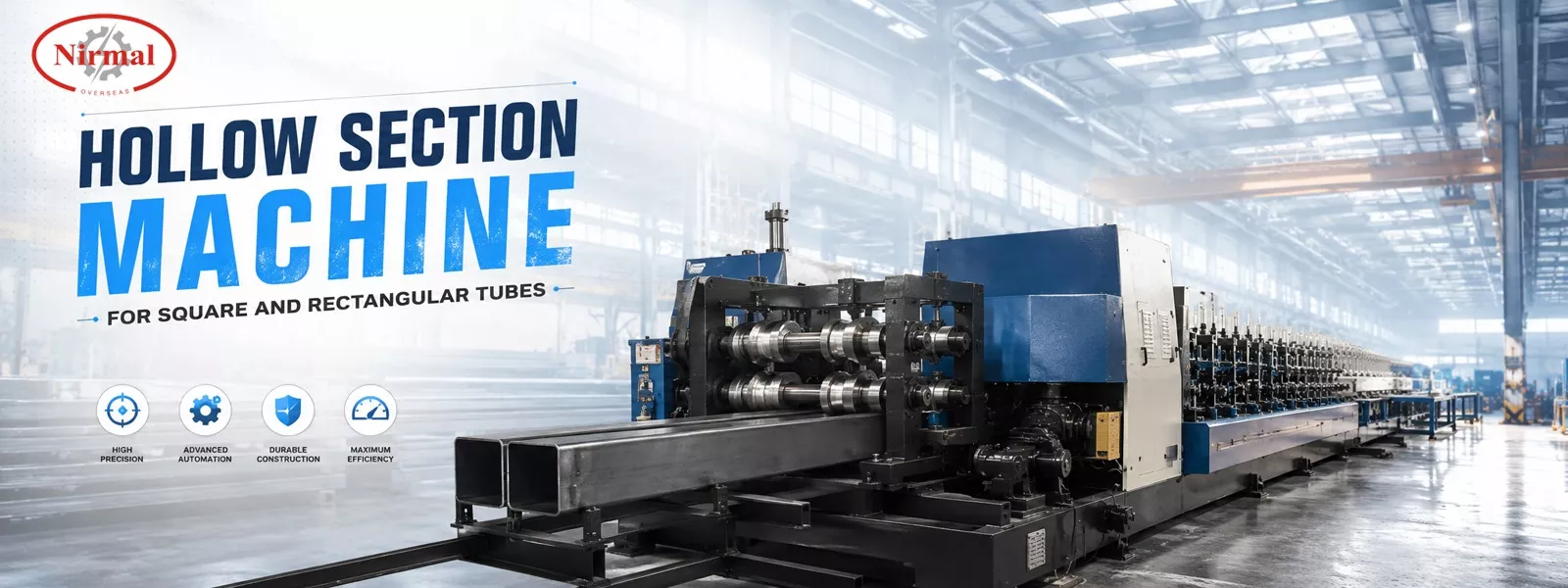
A hollow section for square rectangular machines is industrial tube-forming equipment that converts steel strips or coils into square and rectangular hollow sections (SHS/RHS) through a continuous roll-forming and welding process. These machines are used by steel manufacturers and fabricators to produce structural tubes in defined wall thicknesses and section dimensions, suitable for construction, infrastructure, and industrial applications. Output quality depends on forming speed, weld integrity, and dimensional accuracy.
Key Takeaways
- Hollow section machines produce square (SHS) and rectangular (RHS) tubes from steel coil or strip through cold roll-forming and ERW welding.
- Machine capacity is measured by tube size range (e.g., 20×20 mm to 200×200 mm), wall thickness, and production speed (metres per minute).
- Selecting the right hollow section for square rectangular machine manufacturer in India requires evaluation of after-sales support, tooling quality, and compliance with IS standards.
- These machines are central to construction, pre-engineered buildings, modular furniture, greenhouses, and heavy fabrication sectors.
- Investment cost varies significantly based on automation level, size range, and brand — budget planning should account for tooling, commissioning, and training.
- Indian manufacturers now offer globally competitive machines at a fraction of the import cost, with faster lead times and local support.
- Proper maintenance intervals and operator training directly impact output quality and machine lifespan.
What Is a Hollow Section Machine?
Hollow sections — the square and rectangular tubes seen in steel structures everywhere from bus shelters to high-rise frames — don’t emerge from a forge. They’re produced on specialized roll-forming lines that take flat steel coils, shape it progressively through a series of roller stations, weld the seam, size it, and cut it to length. That production line is what the industry calls a hollow section for square rectangular machine.
The core process involves:
- Decoiling — A steel coil (typically HR or CR steel) is unwound and fed into the line.
- Levelling — The strip is flattened to remove coil-set before forming begins.
- Edge milling (in some configurations) — Strip edges are prepared for a clean weld.
- Progressive roll forming — Horizontal and vertical roll stands progressively bend the flat strip into an open tube profile.
- ERW welding — Electric Resistance Welding fuses the seam longitudinally without filler material.
- Weld bead removal — Inside or outside scarfing removes the weld flash for dimensional consistency.
- Sizing and shaping — The round tube is reshaped into square or rectangular profiles through dedicated sizing stands.
- Straightening — A straightener ensures flatness before cut-off.
- Flying saw or cold saw cut-off — Tubes are cut to length without stopping the line.
- Run-out and bundling — Finished sections are stacked and bundled for dispatch.
The distinction between square (SHS) and rectangular (RHS) production lies in the sizing section: different tooling sets change the cross-section geometry. Most machines switch between the two with a tooling changeover.
Machine Specifications: What to Evaluate
When assessing a hollow section for a square rectangular machine, the specification sheet tells only part of the story. Here’s what actually matters in production:
Size Range and Thickness Capacity
A typical mid-range machine handles sections from 20×20 mm to 150×150 mm (square) and 20×40 mm to 100×200 mm (rectangular), with wall thicknesses from 1.2 mm to 6 mm. Machines designed for structural applications often push to 200×200 mm square or 100×300 mm rectangular.
Mismatching machine capacity to product mix is the most common purchasing mistake. If 60% of your output will be heavy sections (4–6 mm wall), buying a light-duty machine to save capital cost will cost far more in downtime and rejects.
Production Speed
Speed is quoted in metres per minute (m/min). Small machines run at 20–40 m/min; high-production lines reach 80–120 m/min. Speed, however, must be weighed against weld quality: faster lines demand better HF welding systems and tighter process controls. Site engineers evaluating machines on paper should always ask for a production trial at rated speed.
Weld System
High-frequency induction (HFI) welding is standard on modern lines. Key parameters: welding frequency (typically 200–400 kHz), contact or induction coil type, and power rating (kVA). A poorly calibrated weld system — even on a well-built machine — will produce seam failures that only show up during hydrostatic or bend testing.
Tooling Steel and Changeover Time
Tool life is a hidden operating cost. Tooling made from D2 or equivalent alloy steel, hardened to 58–62 HRC, will outlast cheaper alternatives by a factor of three or more. Changeover time between section sizes matters operationally: a machine requiring six hours to swap tooling sets kills flexibility in a job-shop environment.
Drive System
Modern machines use AC variable-frequency drives (VFD) with servo controls on critical stands. Older machines with DC drives or mechanical gearboxes are harder to maintain and less energy-efficient. For new investments, servo-assisted sizing stands with closed-loop feedback improve dimensional accuracy without manual intervention.
Applications in Construction and Industry
The output of a hollow section for square rectangular machine feeds into an enormous range of structural and fabrication uses:
Structural Steel Framing — SHS and RHS are preferred for columns, beams, and bracing in pre-engineered buildings (PEB), industrial sheds, and warehouses. Their closed-section geometry offers excellent torsional rigidity compared to open sections like angles or channels.
Infrastructure Projects — Road signage gantries, pedestrian bridges, railway platform canopies, and bus shelters rely on rectangular hollow sections for span efficiency.
Modular Construction — The repeatability and dimensional consistency of machine-produced hollow sections makes them ideal for modular buildings, where frame units must fit together precisely on site.
Furniture and Interior Fit-out — Lighter sections (1.2–2 mm wall) find use in commercial furniture, shelving systems, and display stands where aesthetics and weldability matter.
Agricultural Structures — Polyhouse and greenhouse frameworks in India typically use galvanized hollow sections. Machines with a galvanized strip input or post-process galvanizing capability serve this market directly.
Solar Mounting Structures — Rectangular sections are increasingly specified for solar panel mounting frames, where corrosion resistance and high strength-to-weight ratios reduce overall system cost.
At Nirmal Overseas, projects spanning commercial complexes to industrial turnkey setups routinely specify hollow sections for primary and secondary structural members — a demand pattern that reflects the broader shift toward tubular steel in Indian construction.
Hollow Section vs. Open Section: A Practical Comparison
Parameter | Square/Rectangular Hollow Section | Angle / Channel (Open Section) |
Torsional stiffness | High | Low |
Fabrication ease | Moderate (requires notching/coping) | High |
Aesthetics | Clean, architectural | Industrial |
Paint/coating efficiency | Closed section protects inner face | All faces exposed |
Weight for equal strength | Often lower | Higher for torsion-sensitive members |
Connection hardware | Welded, bolted end-plate | Bolted gusset or cleat |
IS standard reference | IS 4923 | IS 2062 (structural steel) |
For structural consultants specifying primary frames in PEB projects, the torsional advantage of hollow sections frequently outweighs the slightly higher per-tonne cost. The trade-off shifts in secondary members or bracings where open sections are easier to connect.
Selecting a Hollow Section for Square Rectangular Machine Manufacturer in India
India has developed a credible base of hollow section for square rectangular machine manufacturers in India, ranging from small regional workshops to technically sophisticated engineering firms with export capability. Evaluating them requires looking past the brochure.
Technical Depth
Does the manufacturer design their own roll pass sequences, or do they source forming rolls from a third party and assemble? Proprietary roll pass design — the mathematical sequence that determines how the strip bends at each stand — is the key intellectual differentiator. Ask to see their CAD roll pass designs.
Quality Systems
ISO 9001 certification is a baseline expectation. More informative is how they handle weld testing: do they test by hydrostatic method, eddy current, or destructive bend testing? Manufacturers who conduct production trials with your specific steel grade before delivery reduce site-commissioning risk significantly.
After-Sales Network
A machine that goes down for a week waiting for a forming roll or a weld contact chip is a costly machine. Evaluate the manufacturer’s spare parts inventory, service response time, and whether they have local technicians or depend entirely on factory-based support.
References and Site Visits
Ask for three running installations of similar machine size. Visit at least one. Speak to the production manager, not just the plant owner. Questions worth asking: actual vs. rated speed in daily production, frequency of tooling replacement, any recurring issues, and how quickly the supplier responded to problems.
Compliance with IS 4923
Machines sold for the Indian market should be capable of producing sections meeting IS 4923 (Hollow Steel Sections for Structural Use). Confirm this with dimensional tolerance data from the manufacturer’s production records, not just their claims.
Production Capacity Planning
A common misjudgment is sizing machine capacity to current order volume rather than projected growth over five years. Consider:
- Shift utilisation — A single-shift operation on a 40 m/min machine produces roughly 3–4 tonnes per shift depending on section size. Two shifts double throughput without additional capital.
- Tooling availability — Each product size requires a dedicated tooling set. Budget for at least 8–10 sets for a job-shop mix of sizes.
- Coil yard capacity — Machine output is only as consistent as coil supply. Inadequate coil storage creates interruptions that reduce effective output by 15–25%.
- Downstream finishing — Straightening, end-facing, and bundling capacity must match forming line output. Bottlenecks here reduce apparent machine productivity.
Cost Factors and Budget Planning
Investment cost for a hollow section for square rectangular machine varies widely:
- Entry-level (20×20 to 80×80 mm, basic automation): (contact for pricing) lakhs
- Mid-range (up to 150×150 mm, VFD drives, basic HMI): (contact for pricing) crore
- High-production (up to 250×250 mm, servo controls, automatic changeover): (contact for pricing) crore+
These figures are indicative. Import duties, GST, freight, foundation and civil work, electrical connections, and initial tooling sets can add 20–30% to the base machine cost. Commissioning and operator training typically take 2–4 weeks and should be included in the supplier contract.
Operating costs — power consumption, tooling replacement, maintenance, and consumables — run at roughly 8–12% of capital cost annually for a well-maintained line.
Safety Considerations
Roll-forming lines are not passive machines. Several hazards require systematic control:
- Pinch points in roll stands must be guarded with interlocked guards that stop the line immediately if opened during operation.
- Flying saw debris requires enclosures and eye protection zones. Flying-saw-cut lines produce hot metal chips at high velocity.
- Strip edge hazards — Incoming coil strip edges are razor-sharp. Proper gloves and handling equipment are non-negotiable.
- High-voltage HF welding systems — Access to the weld zone must be controlled by electrical interlocks, not just physical barriers.
- Noise — Operating roll-forming lines typically exceed 85 dB(A). Hearing protection is mandatory in production areas.
A machine supplier who provides documented safe operating procedures (SOPs) and risk assessment documentation as part of commissioning is demonstrating the kind of professionalism that matters over a machine’s 15–20 year operating life.
Industry Trends
Several shifts are affecting both machine design and the hollow section market in India:
Tighter dimensional tolerances — As Indian construction adopts BIM (Building Information Modelling) workflows, contractors increasingly demand sections that match model dimensions within ±0.5 mm rather than the broader IS 4923 tolerances. Machine builders are responding with servo-controlled sizing.
Thinner, higher-strength steels — Demand for sections made from S355 and above is growing. Older machines designed for S250 struggle with springback and weld heat management on higher-strength grades. New machine designs address this through adjustable roll pass geometry.
Energy efficiency — VFD-based lines consume 15–25% less power than older DC-drive equivalents. This is increasingly a procurement criterion, particularly for buyers with high electricity costs.
Galvanizing integration — Producers serving the agricultural and solar sectors want inline or batch galvanizing capability. Some machine builders now offer integrated lines.
Digital monitoring — Basic SCADA integration for production logging, weld parameter recording, and predictive maintenance alerts is becoming standard on mid-range and above machines.
Frequently Asked Questions
Q1: What is a hollow section for square rectangular machine?
It is a roll-forming production line that converts flat steel strip into square (SHS) or rectangular (RHS) hollow sections through progressive forming, ERW welding, and sizing operations. Output sections are used in structural, fabrication, and industrial applications.
Q2: What steel grades can these machines process?
Most standard machines handle IS 2062 Grade A and B (equivalent to S250/S275). Higher-end machines process up to S355 or even S420 with appropriate weld power and forming adjustments.
Q3: What is the typical production output per shift?
Depending on section size and wall thickness, output ranges from 2.5 to 6 tonnes per shift on a mid-range machine running at 30–50 m/min.
Q4: How long does it take to change tooling between section sizes?
On manually changed machines, 3–6 hours is typical. Quick-change tooling systems available on higher-specification machines reduce this to 60–90 minutes, significantly improving flexibility.
Q5: Are Indian-made hollow section machines comparable to European or Taiwanese machines?
For standard size ranges and IS 4923 production, yes — several Indian manufacturers offer machines with equivalent accuracy and durability at 30–50% lower cost. For very high-speed lines or very tight tolerances (for export to European markets), imported machines may still have an edge.
Q6: What IS standard applies to hollow sections produced on these machines?
IS 4923 (Hollow Steel Sections for Structural Use) is the primary standard. Some projects also specify IS 1161 (Steel Tubes for Structural Purposes) depending on application.
Q7: How much space does a hollow section machine require?
A mid-range line (up to 150×150 mm) typically requires a floor area of approximately 25–40 metres in length and 6–8 metres in width, plus a separate coil storage and run-out area.
Q8: What power supply is needed?
A mid-range machine requires a 3-phase power supply, typically 150–300 kVA depending on the HF welding system size. High-production lines may require 500 kVA or more.
Q9: What is the machine lifespan?
A well-maintained machine from a reputable manufacturer has a productive life of 15–20+ years. Forming rolls, weld contacts, and saws are consumable items replaced on a regular maintenance schedule.
Q10: Do hollow section machines require specialized operators?
Yes. At minimum, one trained operator per shift is essential, supported by a maintenance technician. Machine suppliers typically provide 2–4 weeks of on-site training during commissioning. Ongoing skill development reduces scrap and downtime significantly.
Q11: Can the same machine produce both square and rectangular sections?
Yes. Most machines produce both with a tooling changeover. Some configurations allow partial changeovers (adjusting only the sizing section) for faster switches within a related family of sizes.
Q12: What certifications should I look for in a manufacturer?
ISO 9001 quality management certification is baseline. CE marking is relevant for export-oriented lines. For Indian-market machines, verify that the supplier can provide IS 4923 compliance test reports from their own production.
Q13: Is there a hollow section machine suitable for small-scale production?
Yes — compact machines designed for sections up to 60×60 mm or 40×80 mm are available for workshop-scale operations, with lower capital investment and smaller footprint.
Q14: What maintenance is required?
Daily checks include lubrication of roll stands, weld contact inspection, and dimensional verification of output. Weekly: drive system checks, HF coil inspection. Monthly: full electrical and mechanical survey. Preventive maintenance schedules provided by the manufacturer should be followed strictly.
Q15: How do I evaluate a hollow section for square rectangular machine manufacturer in India?
Evaluate technical capability (proprietary roll pass design, in-house tooling manufacturing), quality systems (ISO certification, production testing protocols), after-sales support (spare parts availability, service response), and references from operating installations of comparable machine size.
Conclusion
Choosing the right hollow section for square rectangular machine is a long-term capital decision that affects production economics for the next two decades. The market for these machines in India is mature enough that buyers have genuine choice — between local manufacturers offering competitive pricing and regional support, and imported machines where the premium may be justified for specific high-precision applications.
The fundamentals that separate a sound investment from a costly mistake are consistent: match machine capacity to your realistic product mix, evaluate tooling quality and changeover flexibility, insist on production trials with your steel grades, and treat after-sales infrastructure as seriously as the machine specification itself.
For structural projects where hollow section sourcing or turnkey supply is the priority rather than manufacturing, working with an experienced supply and project partner — one familiar with the full specification and application chain — ensures that section selection, procurement, and site delivery are handled with the technical rigour the application demands.
Nirmal Overseas Private Limited is a manufacturer and project execution specialist with experience across commercial, industrial, and infrastructure projects. For structural steel requirements and turnkey project enquiries, visit nirmaloverseas.com.