

Quick Answer
Hot dip galvanizing is a corrosion-protection process where steel or iron parts are dipped into molten zinc at around 445-465°C. The zinc reacts with the steel surface and forms layers that resist rust for decades, even outdoors. In India, galvanizing companies use this method to treat pipes, structural steel, transmission towers, and fasteners for construction, power, and infrastructure projects. The right galvanizing plant, kettle size, and pre-treatment quality determine how well the coating holds up once the steel is on-site.
Steel rusts. That single fact drives an entire industry in India built around protecting steel before it reaches a construction site or transmission tower. Hot dip galvanizing is the most widely used method for this protection, and it shows up everywhere: highway crash barriers, transmission line towers, water pipelines, and prefabricated steel structures.
If you’re a contractor, project engineer, or fabricator searching for “galvanizing near me,” “hot dip galvanizing near me,” or “galvanizing plant near me,” while comparing galvanizing companies, you’re likely trying to answer a few practical questions: how the process works, what it costs, how long it lasts, and how to judge whether a plant can handle your project size. This guide answers all of that, and adds a section for anyone evaluating or setting up a galvanizing plant of their own, since plant selection is where a lot of project delays and quality issues actually start.
What Is Hot Dip Galvanizing?
Hot dip galvanizing is a metal coating process where fabricated steel is submerged in a bath of molten zinc, typically held between 445°C and 465°C. The zinc reacts with the iron in the steel to form a series of zinc-iron alloy layers, topped with a layer of pure zinc. This layered structure is what gives galvanized steel its corrosion resistance.
Unlike paint or powder coating, hot dip galvanizing creates a metallurgical bond, not just a surface film. The coating moves with the steel through minor bending, and it doesn’t peel the way a sprayed-on finish can. That’s why galvanizing companies market it as long-term protection rather than cosmetic finishing, typically rated for 25 to 50+ years of service life depending on the environment.
There’s also a difference worth clarifying upfront: hot dip galvanizing is not the same as electro-galvanizing. Electro-galvanizing deposits a thin zinc layer through electricity, giving a smoother finish but a much thinner, less durable coating. Hot dip galvanizing produces a thicker, rougher coating built for outdoor exposure, structural steel, and industrial pipe.
How Does the Hot Dip Galvanizing Process Work?
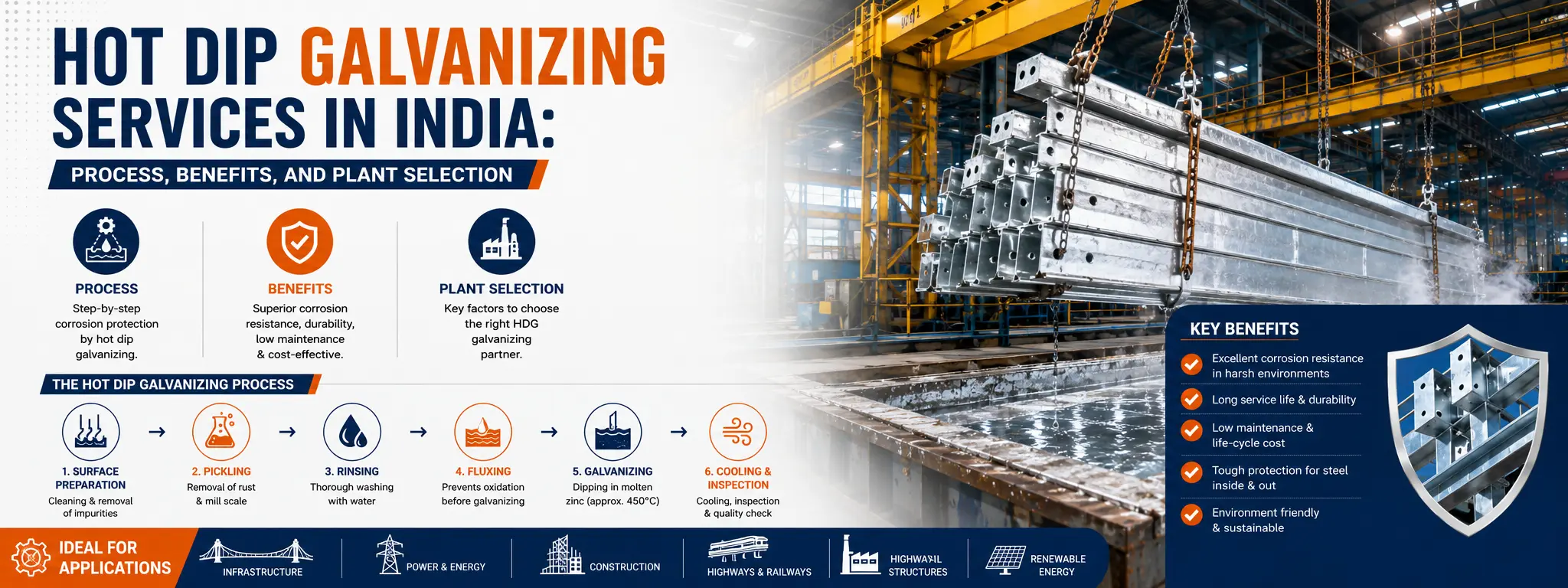
The process runs through five distinct stages inside a galvanizing plant, and skipping any one of them affects coating quality.
- Surface preparation (degreasing): Steel is cleaned in an alkaline or acid solution to strip oil, grease, and dirt.
- Hot Dip Galvanizing Services in India: Process, Benefits, and Plant SelectionPickling: The steel goes into a diluted acid bath, usually hydrochloric acid, to remove mill scale and rust.
- Hot Dip Galvanizing Services in India: Process, Benefits, and Plant SelectionFluxing: A zinc ammonium chloride flux bath prepares the surface to accept zinc and prevents oxidation before dipping.
- Hot Dip Galvanizing Services in India: Process, Benefits, and Plant Selection Dipping: The steel is lowered into a kettle of molten zinc, where the metallurgical reaction happens within minutes.
- Hot Dip Galvanizing Services in India: Process, Benefits, and Plant Selection Cooling and inspection: The galvanized steel is cooled in water or air, then checked for coating thickness, uniformity, and bare spots.
For pipe and tube products, the process runs on a continuous line, where pipe passes through each stage automatically. For structural steel, fabricators use batch galvanizing, where individual pieces or bundles are dipped into a kettle sized to the plant’s capacity. Nirmal Overseas builds both configurations, structure galvanizing plants and pipe galvanizing plants, because the equipment and kettle handling differ significantly between the two.
Which Industries Rely on Hot Dip Galvanized Steel?
Galvanized steel shows up in nearly every sector that puts steel outdoors or underground.
- Power transmission and distribution: transmission towers, cross-arms, and substation structures
- Water infrastructure: pipelines, water tanks, and treatment plant structures
- Road and highway projects: crash barriers, streetlight poles, signage structures
- Telecom: mobile towers and antenna mounts
- Solar: mounting structures for ground-mounted and rooftop solar plants
- General construction: purlins, roofing structures, staircases, and railings exposed to weather
- Agriculture: greenhouse frames and storage structures
Project engineers on these projects specify galvanized steel for one main reason: it removes the recurring maintenance cost of repainting exposed steel every few years.
What Are the Benefits of Hot Dip Galvanizing?
- Long service life: 25 to 50+ years depending on atmospheric exposure, with minimal maintenance.
- Full coverage: molten zinc reaches recesses, corners, and internal surfaces that spray coatings miss.
- Impact resistance: the zinc-iron alloy layers resist chipping and abrasion during transport and installation.
- Cost predictability: one galvanizing cycle instead of repeated repainting cycles over the structure’s life.
- Speed: a batch of structural steel can be galvanized in hours, not the days a multi-coat paint system needs.
- Cathodic protection: even if the coating gets scratched, the surrounding zinc continues protecting the exposed steel.
What Are the Limitations of Hot Dip Galvanizing?
Being direct about limitations here matters, because overselling any coating system leads to problems on-site later.
- Size constraints: kettle size at a galvanizing plant limits the maximum length and dimensions of a single piece. Oversized members may need sectional or double-dipped galvanizing.
- Appearance variability: spangle pattern and finish can vary between batches, which matters for architectural exposed steel.
- Distortion risk: thin or unevenly welded sections can warp slightly from the heat of the zinc bath if fabrication design doesn’t account for it.
- Not a substitute for design: galvanizing protects the surface; it doesn’t correct poor drainage design, trapped moisture points, or missing vent holes in hollow sections.
A good fabricator designs parts with galvanizing in mind, vent holes, drain holes, and kettle-size limits, rather than treating it as an afterthought.
Hot Dip Galvanizing vs Other Corrosion Protection Methods
The table below compares the four most common corrosion protection methods used on Indian construction and infrastructure projects.
Method | Coating type | Typical service life | Best suited for |
Hot dip galvanizing | Metallurgical zinc-iron bond | 25-50+ years | Structural steel, pipe, outdoor exposure |
Electro-galvanizing | Thin electroplated zinc | 5-15 years | Fasteners, indoor components, cosmetic finish |
Zinc-rich paint | Surface film | 5-10 years | Site touch-up, repair of galvanized coating |
Powder coating | Surface film (no zinc) | 10-20 years | Indoor furniture, architectural elements |
How to Choose the Right Galvanizing Company
When searching for “galvanizing near me” or comparing galvanizing companies, evaluate providers on the following:
- Kettle size and plant capacity: match this to your longest and heaviest structural members before committing.
- Turnaround time: continuous pipe lines run faster than batch structural galvanizing; ask for realistic dispatch schedules, not best-case estimates.
- Coating thickness testing: ask whether the plant tests dry film thickness per piece or per batch, and against which standard (IS 2629, IS 4759, or ASTM A123).
- Pre-treatment quality: poor pickling or fluxing is the most common cause of bare spots and coating failure.
- Handling and logistics: galvanized steel is heavy and can scratch during loading; ask how the plant protects finished coating during transport.
- Track record on similar projects: a plant that has handled transmission structures, pipelines, or API-grade pipe for your industry understands the tolerances your project needs.
Plant Selection: What Matters If You’re Setting Up Your Own Galvanizing Line
Some readers researching this topic aren’t looking for a service provider. They’re evaluating whether to install a galvanizing plant of their own, often alongside an existing tube mill, slitting line, or fabrication unit. For that audience, plant selection comes down to a few decisions.
- Pipe galvanizing vs structure galvanizing: a continuous pipe galvanizing plant is built around line speed and pipe diameter range. A structure galvanizing plant is built around kettle length, width, and depth, sized to the largest fabricated component you expect to run.
- Kettle material and heating: kettle life and zinc consumption depend on the heating method (fuel-fired or induction) and kettle steel grade.
- Effluent and fume handling: pickling and fluxing generate acid fumes and effluent that need treatment systems built into the plant design, not added later.
- Integration with existing lines: manufacturers running tube mills or cut-to-length lines often add a galvanizing plant to capture that value in-house instead of outsourcing it. Nirmal Overseas has executed this kind of turnkey integration on projects such as its Bina Metal and GI Pipe installations, where slitting, pipe-making, and galvanizing equipment were commissioned as one connected line.
Choosing a plant builder with experience across tube mills, API pipe mills, and both pipe and structure galvanizing plants reduces the coordination risk of running these as separate vendor purchases.
What Does Hot Dip Galvanizing Cost?
Galvanizing is priced per kilogram of steel processed, and the rate depends on:
- Surface area to weight ratio: thin, complex fabrications like lattice towers cost more per kg than simple thick sections, because they need more zinc coverage relative to their weight.
- Zinc price: zinc is a globally traded commodity, so galvanizing rates move with zinc futures.
- Coating thickness specification: a heavier coating requirement for coastal or industrial atmosphere exposure uses more zinc per piece.
- Volume and repeat business: regular fabricators with consistent volumes typically negotiate better rates than one-off jobs.
As a rough guide, structural hot dip galvanizing in India commonly runs in the range of ₹15-35 per kg depending on the factors above, though large or unusually shaped fabrications can fall outside this range. Get a quote based on your actual drawings rather than budgeting off a generic per-kg figure.
Safety Considerations in Hot Dip Galvanizing
- Molten zinc bath temperature exceeds 450°C, so kettle-side operations require heat-resistant PPE and controlled access.
- Pickling acid handling needs proper ventilation, spill containment, and neutralization procedures.
- Zinc fume exposure during dipping requires fume extraction systems at the kettle.
- Sealed hollow sections must be vented before dipping. An unvented sealed cavity can trap air or moisture that expands violently in the zinc bath.
- Effluent from pickling and fluxing must be treated before discharge, per state pollution control board norms.
A galvanizing plant’s safety record is a reasonable proxy for its overall process discipline, worth asking about directly when shortlisting a provider.
Industry Trends in Hot Dip Galvanizing
- Continuous pipe galvanizing lines are replacing older batch setups for high-volume GI pipe manufacturing, driven by speed and consistency.
- Duplex systems, powder coating applied over galvanized steel, are gaining ground for architectural and coastal projects that need both corrosion resistance and color.
- Solar mounting structure demand has become a meaningful new volume driver for structure galvanizing plants, given India’s ground-mounted and rooftop solar capacity additions.
- Automation in pre-treatment, automated pickling and fluxing lines, is reducing rework rates tied to inconsistent manual dipping.
Future Outlook
Infrastructure spending on transmission networks, highways, water pipelines, and solar capacity keeps galvanized steel demand tied to India’s broader construction and power sector growth. For fabricators and manufacturers, that makes in-house galvanizing capacity, or a dependable long-term galvanizing partner, an operational decision that affects project timelines as much as it affects cost.
Key Takeaways
- Hot dip galvanizing dips fabricated steel into molten zinc (445-465°C) to form a corrosion-resistant metallurgical coating.
- The process runs through five stages: degreasing, pickling, fluxing, dipping, and cooling/inspection.
- Coating life typically ranges 25 to 50+ years depending on exposure conditions.
- Pipe galvanizing runs on continuous lines; structural steel uses batch kettle dipping.
- Kettle size limits maximum part dimensions; oversized pieces need sectional galvanizing.
- Compare galvanizing companies on kettle capacity, turnaround time, coating thickness testing, and pre-treatment quality.
- Vent holes in hollow sections are a safety requirement, not an optional design detail.
- Costs are priced per kg and vary with surface area, zinc price, and coating thickness spec.
- Manufacturers integrating tube mills or slitting lines with an in-house galvanizing plant reduce outsourcing and coordination risk.
Frequently Asked Questions
What is hot dip galvanizing?
Hot dip galvanizing is a process where steel is dipped into molten zinc to form a corrosion-resistant coating that bonds metallurgically with the steel surface, rather than sitting on top like paint.
How long does hot dip galvanized steel last?
Typically 25 to 50+ years, depending on atmospheric exposure. Coastal or industrial environments shorten this range; dry inland environments extend it.
What’s the difference between hot dip galvanizing and electro-galvanizing?
Hot dip galvanizing produces a thicker, metallurgically bonded coating suited to outdoor structural steel. Electro-galvanizing produces a thinner, smoother coating suited to indoor components and fasteners, with a shorter service life.
Can any steel shape be hot dip galvanized?
Most fabricated steel can be galvanized, but hollow sections need vent and drain holes, and part size is limited by the galvanizing plant’s kettle dimensions.
Is hot dip galvanizing suitable for large infrastructure projects?
Yes. It’s the standard corrosion protection for transmission towers, pipelines, highway structures, and solar mounting systems across India.
How much does hot dip galvanizing cost per kg?
Rates commonly fall in the ₹15-35 per kg range in India, depending on part geometry, coating thickness spec, and zinc prices, though a quote against actual drawings is more reliable than a general estimate.
What standards govern hot dip galvanizing in India?
IS 2629 and IS 4759 cover galvanizing practice and coating requirements for structural steel; ASTM A123 is the commonly referenced international equivalent.
What causes bare spots or coating failure?
Most failures trace back to inadequate pickling or fluxing before dipping, or design issues like unvented cavities and trapped debris on the steel surface.
Should I choose a galvanizing company or set up my own plant?
If you have consistent, high volume through an existing tube mill, slitting line, or fabrication unit, an in-house galvanizing plant can reduce turnaround time and outsourcing cost. Lower or irregular volumes usually favor outsourcing to an established galvanizing company.
What’s the difference between a pipe galvanizing plant and a structure galvanizing plant?
A pipe galvanizing plant runs pipe continuously through the process at speed. A structure galvanizing plant uses a kettle sized for batch-dipping fabricated components like towers, purlins, and brackets.
Does hot dip galvanizing affect the strength of steel?
No. The process doesn’t reduce the base steel’s mechanical properties when standard fabrication and venting practices are followed.
Can galvanized steel be painted afterward?
Yes, this is called a duplex system. It adds a color finish and extra protection, and is increasingly used for architectural and coastal applications.
How do I find a reliable galvanizing company near me?
Check kettle capacity against your part sizes, ask about coating thickness testing standards, review their track record on similar projects, and confirm realistic turnaround times rather than best-case promises.
What maintenance does hot dip galvanized steel need?
Very little under normal conditions. Periodic visual inspection for coating damage after installation is typically sufficient; touch-up with zinc-rich paint handles any scratched areas.
Conclusion
Hot dip galvanizing remains the most dependable corrosion protection method for structural steel and pipe used across India’s infrastructure, power, and construction sectors. Whether you’re comparing galvanizing companies for a project or evaluating plant equipment to bring galvanizing in-house, the fundamentals stay the same: match kettle capacity to your part sizes, verify pre-treatment quality, and test coating thickness against the right standard.
Nirmal Overseas designs and builds both hot dip pipe galvanizing plants and hot dip structure galvanizing plants as part of its turnkey manufacturing line-up, alongside tube mills, slitting lines, and cut-to-length equipment, for manufacturers looking to integrate galvanizing capacity into their existing production setup.