

C Section Door & Window Machine Manufacturer in India
OUR OFFICES
KHASRA NO – 134/9/2, VILLAGE-BARHANA TEHSIL-BERI, JHAJJAR HARYANA – 124107
nirmal@nirmaloverseas.com
info@nirmaloverseas.com
+91-9817975382 / 79
OUR BROCHURE
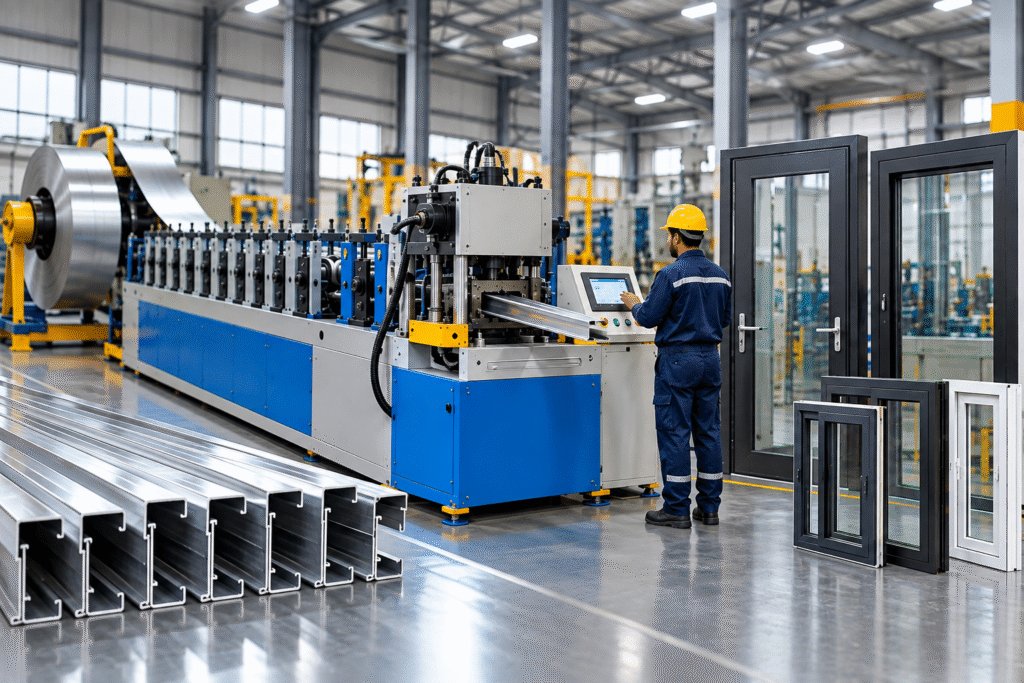
Roll forming machines that turn galvanized steel coil into accurate C section door and C section window profiles. Built by Nirmal Overseas in Haryana, installed and supported across India.
Since 1983 | ISO & CE certificates | Government-recognised Export House | 2,000+ projects supplied
C Section Door & Window Roll Forming Machine: Overview
A C section door and window machine is a roll forming line that shapes flat galvanized steel strips into C profiles: web, two flanges, and a return lip. These profiles become door frames, window frames, and shutter guides. One machine delivers uniform sections with far less manual bending.
The same machine family from Nirmal Overseas Private Limited also forms U and Z sections for doors and windows, with tooling matched to your drawings.
Key Features of Nirmal C Section Machines
- Consistent C section profiles: Precision-set roller stations hold web, flange, and lip dimensions, so frames fit square.
- Low running cost: Efficient drives keep power use low, and automation cuts labour and scrap.
- Heavy-duty machine build: Designed for tough work and a long service life.
- Easy operation and training: A simple interface helps operators learn quickly, and we provide training.
- Strong, light door and window frames: Cold-formed steel gives high stiffness from thin, economical coil.
Technical Specifications of C Section Door & Window Machine
Parameter | Details |
Sections produced | C, U, and Z profiles for doors and windows |
Input material | Galvanized steel coil |
Typical section material | Galvanized steel, 0.8–2.0 mm, Z120–Z275 coating |
Installation | Support and operator training across India |
Specifications are customized to your C section drawing and output target.
C Section Machine Configurations: Door, Window, Multi-Section and Purlin Lines
- C section door frame machine: Heavier gauge C sections for main doors and industrial doors.
- C section window machine: Lighter gauge C and U sections for casement and fixed windows.
- Multi-section machine: C, U, and Z profiles on one machine, with tooling changed as orders change.
- C section purlin machine: Heavier C and Z sections for roof framing in sheds and prefab buildings.
Not sure which C section machine fits? Share your product list and we will suggest one.
C Section vs U Section for Doors and Windows: Which Profile to Choose?
- C section (with lip): Stiffer at the same thickness. Best for main door frames, hinge sides, heavy windows, and factory or cold-store doors. Common gauge 1.2–2.0 mm.
- U section (no lip): Lighter and cheaper. Suits small windows, channels, and glazing guides. Common gauge 0.8–1.5 mm.
Gauge ranges are typical; final gauge depends on door weight. On a door frame, the lip matters most at the hinge, where screws load the flange.
How a C Section Machine Works: Coil to Finished Profile?
- Decoil and level: Galvanized coil is uncoiled and flattened.
- Punch (optional): Hinge, lock, and fixing holes are made before forming.
- Roll form: Progressive roller stations shape the web, flanges, and lip.
- Cut to length: Sections are cut to size and run out for stacking.
Every machine is tested before dispatch. Ask for a trial run on your own coil to check first-piece dimensions, twist, and coating. Coil hardness changes between batches and shifts springback, so a good operator re-checks the first piece after every coil change — this applies across all our machines, not just this one.
Why Choose Nirmal Overseas as Your C Section Machine Manufacturer in India?
Choosing a C section door manufacturer in India comes down to proof, precision, and support.
- Proof: In business since 1983, with ISO and CE certificates and Government-recognised Export House status. 2,000+ projects supplied, including turnkey plants in the Middle East and Africa.
- Precision: Roller stations and controls engineered for consistent output. Ask for written tolerances on section size and cut length.
- Support: Installation help, operator training, and maintenance support from our Jhajjar, Haryana factory.
- One-source coil line: Add a slitting line or cut-to-length line for coil preparation from the same manufacturer.
Roll forming is core engineering for us: we build tube mills and HF welders in-house. See our turnkey projects for plants we have delivered.
Applications of C Section Machine by Industry
- Door and window fabricators: Steady output of matching C section frames for housing and commercial projects.
- Prefab and PEB builders: C section frames and purlins as prefab construction material, in bulk.
- Warehouses and industrial sheds: Dock-door frames, shutter guides, and roof purlins for structural steel framing.
- Residential housing projects: Hundreds of matching C section door frames, with hinge and lock positions aligned.
What to Check Before Buying a C Section Machine
- Match gauge to door weight, not to the lowest quote. Thin C section gauge saves steel but racks at the hinge.
- Check zinc coating, not just thickness. Ask for the mill test certificate, and choose heavier coating for coastal sites.
- Confirm tooling changeover. A single-size machine sits idle when demand shifts.
- Verify certification and support in writing: ISO, CE, installation, training, and maintenance.
FAQs
Is a C section window strong enough for large glass panels?
It depends on gauge, span, and glazing weight. The return lip stiffens the frame, but large panes still need heavier gauge or a mullion to limit deflection. For big openings, check the section against the glass weight before you finalize the design.
How is the price of a C section machine decided?
Price depends on the thickness range, section sizes, number of forming stations, and the level of automation. A punching unit, flying cut-off, and PLC control add cost. Tell the manufacturer your coil thickness, section drawings, and daily output, and ask for a quote based on those.
Why does a C section door frame twist or bow after roll forming?
Common causes are uneven coil hardness, misaligned or worn rollers, and a setup that does not suit the coil thickness. Twist and bow show up on a flat-bed check. Re-check the first piece after every coil change, and re-align the roller stations if the fault repeats.
Which steel is used for C section windows and doors?
Most fabricators use galvanized steel (GI) coil, typically 0.8 to 2.0 mm thick depending on load. GI resists rust better than plain cold-rolled steel. For coastal sites or outdoor use, choose a heavier zinc coating and ask for the mill test certificate.
Do you provide installation and training for C section machines?
Yes. We assist with installation and operator training for C section machines across India. Timelines depend on the machine and your site, so we confirm the schedule in your quotation. Training covers setup, roller adjustment, and first-piece checks. Ask for the full scope when you request a quote.
Get in touch for the C Section Machine
The right C section machine keeps every frame square, from the first piece to the last coil. We would be glad to help you find it.
Share your C section drawing, coil thickness, and target output, and our team will suggest a suitable configuration and send a quotation. No obligation, no pressure to decide.