

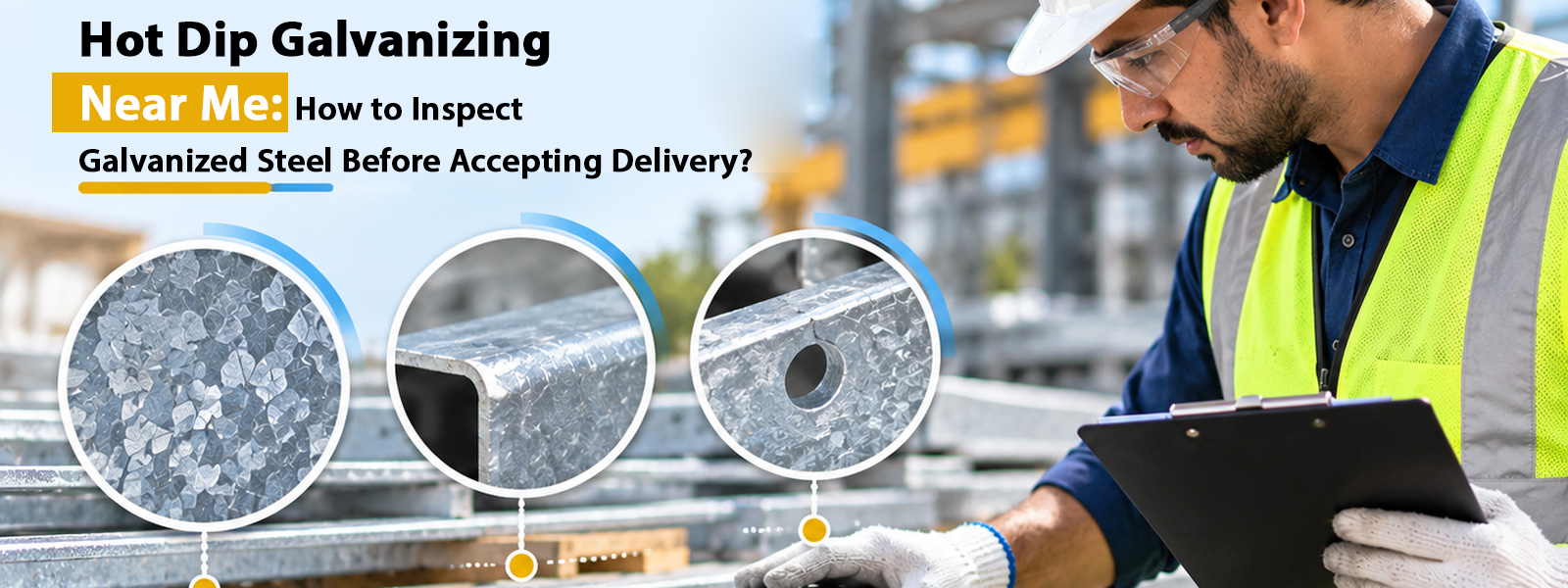
A truck arrives with 200 galvanized purlins, the driver wants a signature, and nobody has checked a single piece. This guide is for fabricators, contractors, pipe and structure manufacturers and purchase managers who have searched for hot dip galvanizing near me and now have to live with the result. By the end, you will know how to vet a galvanizer, how to inspect and measure the coating at delivery, and how to decide between accept, repair and reject.
How to Choose a Hot Dip Galvanizing Plant Near You Before Giving Your First Order?
A map search gives you names, not quality. Before you give a first order to any galvanizing company, check these points.
Kettle size. Ask for the internal length, width and depth. A 12 m member in a 6 m kettle means double dipping, which leaves an overlap band and raises the risk of distortion. If your longest piece does not fit in one dip, agree in writing how it will be handled.
Your type of steel. Silicon and phosphorus in the steel change how the zinc-iron alloy layers grow. Reactive steel gives a thick, dull, sometimes brittle coating. Ask whether the plant has handled your material, whether tube, angles, castings or welded assemblies.
Records and standard. A good plant works to IS 4759, IS 2629 or ISO 1461 and can show a thickness report and a gauge with calibration records. “We check by eye” is not an answer.
What to see on a visit. Look at the pickling tanks: is the acid clear or full of iron sludge? Check the flux and drying area, the dross and ash on the zinc bath, and how finished steel is stored. Material should sit on timber spacers, off the ground and under cover. Ask which zinc grade they buy and whether they keep purchase records.
Red flags. They refuse a visit. They will not issue a thickness report. They quote a very low rate per tonne without asking one question about your steel. Finished goods lie wet in the yard.
If you are comparing galvanizing plants in your area and want the process basics first, read our hot dip galvanizing process and plant selection guide.
Documents to Ask the Galvanizer For Before and With Delivery
Inspection starts on paper. Ask for these when you place the order and check them again at the truck:
- A test report that names the standard applied
- A coating thickness report in micron (µm), by item or lot
- A material description with section sizes and steel thickness, since the required coating depends on thickness
- The applicable standard written on the order: IS 4759, ISO 1461 or ASTM A123, and IS 4736 for tubes
- A challan whose quantity and weight match the load
A lot that weighs well below expected may be under-coated or short.
Visual Inspection of Galvanized Steel: What Good and Bad Zinc Coating Looks Like?
A good coating is continuous, fairly smooth and silver to dull grey. Spangle size is not a quality marker. Inspect in daylight from about 1 m, and pull pieces from the middle and bottom of the stack, not only the top.
Bare or Uncoated Spots on Galvanized Steel
Dark patches where zinc did not bond. Causes include weld slag, paint, oil or marker left on the steel, or weak pickling. Red rust at the spot after a few days confirms bare steel. A few small spots can be repaired. Many spots mean surface preparation failed.
Zinc Runs, Drips and Lumps
Zinc that did not drain sets as teardrops and thick edges, mostly at the lower end of the piece. Light drips are cosmetic. Lumps in bolt holes, threads or mating faces must be removed before acceptance.
Dross Inclusions and Rough Surface
Dross is zinc-iron particles from the bath. When it sticks to steel, it shows as hard, gritty bumps. A few lumps are cosmetic. Dross across the whole lot points to poor bath maintenance. A sandpaper-like surface can also come from reactive steel, so it is not always the galvanizer’s fault.
Ash and Flux Stains
Dark smears or crusty residue come from bath ash or flux that was not fully dried. Wipe with a cloth. If the coating underneath is intact, it is a stain. If zinc is missing, treat it as a bare spot.
Blisters and Peeling of Zinc Coating
Raised bubbles or flaking mean poor adhesion or trapped gas, often from cast surfaces, rolled-in scale or contamination. Press a blunt tool at the edge of a blister. If the coating lifts, reject the piece.
Blocked Vent and Drain Holes in Hollow Sections
Hollow sections need vent and drain holes so air escapes and zinc drains. Look into each hole. A dull thud when you tap the piece suggests trapped zinc. Bulging seams suggest poor venting, which is also a safety risk at the kettle.
Distortion or Warping After Galvanizing
Thin plates, long slender members and unsymmetrical fabrications move in the kettle from heat and release of stress. Lay a straightedge or string along the piece. Agree a tolerance in advance, since some bow is normal on thin sections.
White Rust vs Normal Grey Patina on Galvanized Steel
White rust is a powdery white or wet-looking deposit that forms when fresh galvanized steel is stacked tight and stays damp. Patina is the even dull grey zinc that develops in air over weeks, and it is normal. Light white rust brushes off. Heavy deposits that have eaten into the zinc are a storage problem. Red rust through the coating means the zinc is gone.
From the plant floor: Black spots that appear only after drying are often weld spatter or marker paint that nobody removed before pickling. Acid does not remove them. Have your fabricator grind spatter and avoid paint marking.
How to Check Zinc Coating Thickness on Galvanized Steel with a Gauge?
Eyes cannot judge thickness. Use a magnetic gauge made for coatings on steel (see ISO 2178). Calibrate it on a reference foil and zero it on bare steel before you start.
Where to measure. Take readings on flat, clean areas, at least 25 mm from edges, corners and welds. Avoid drips and lumps.
How many readings. Standards divide the lot into reference areas, and each area needs several readings. For very small lots, every piece is measured. Larger lots are sampled. Mark the pieces you measured.
Local vs average. The local value is the minimum allowed in any single reference area. The mean is the average across the lot. A lot can pass on average and still fail if one area drops below the local minimum.
What numbers to compare against. The required thickness depends on the steel thickness and on the standard named in your order. For example, ISO 1461 asks for a local minimum of 70 microns and an average of at least 85 microns on steel thicker than 6 mm. Thinner steel needs less. If your order is under IS 4759, use the values in that standard and your contract. One micron is one-thousandth of a millimetre, and your gauge reads directly in microns.
Castings, threaded parts and mixed-thickness assemblies have separate rules. Check the standard.
Simple Tests to Check Zinc Coating Quality at Delivery
For adhesion, tap or press a blunt tool near an edge and look for flaking. Do not prise at the zinc with a knife or chisel, since that damages good coating too.
The Preece (copper sulphate) test under IS 2633 checks coating uniformity. A bright red copper deposit shows where zinc was thin or missing. It suits tubes, wire and small parts. Follow the standard for method and pass criteria.
Photograph any failure and report it the same day. Lab testing is for disputes. For routine acceptance, gauge readings and a careful visual check are enough.
Inspection Checks for Galvanized Pipes vs Galvanized Structural Steel
Galvanized Pipes: Bore, Ends, Threads and Weld Seam
Look down the bore with a torch. It should show continuous zinc, not black patches or lumps. Check ends for zinc plugs and heavy buildup, because a pipe lot rejected for blocked ends usually points to poor draining at withdrawal. Fittings should start on threads by hand. On a welded pipe, run your eye along the seam for bare lines or rough zinc.
If your pipes also need pressure testing, our note on hydro testing and pipe straightening explains what that test does and does not tell you.
Galvanized Structural Steel: Bolt Holes, Threads, Welds, Angles and Channels
Bolts should pass through holes without reaming. Check nuts, bolts and rods for clogged threads. Inspect welded joints for bare patches and slag marks. On angles and channels, look inside corners and on the back of the section for drips and thin zinc, and take gauge readings on flat faces, not at the heel.
From the plant floor: Pieces in the middle of a bundle often show thin coating at the points where they touched each other in the kettle. Check where bundles made contact.
Accept, Repair or Reject Galvanized Steel: How to Decide?
Accept when thickness meets both local and mean values and defects are cosmetic, such as light drips, small dross bumps or light white rust.
Repair when bare areas are small. ISO 1461 limits touch-up to a small share of the surface, about 0.5%, with no single area above about 10 cm². Acceptable methods are zinc spray or zinc-rich paint on clean, ground or blasted steel, applied to the thickness the standard requires. A quick brush of silver paint is not a repair.
Rework or re-dip when bare areas exceed the limit, when thickness is below the local minimum across many areas, or when blisters and peeling appear. Re-dipping means stripping and recoating, which adds time and some distortion risk. Agree in writing who bears the cost.
Reject when the coating flakes, hollow sections are filled with zinc, or distortion makes the piece unusable.
Photograph defects with a tape in the frame, note piece numbers, challan number and date, and email the galvanizer the same day. Verbal complaints get forgotten.
Common Mistakes Buyers Make When Inspecting Galvanized Steel at Delivery
- Checking only the top layer of the stack, when the worst pieces are often underneath
- Accepting a good-looking lot without a single thickness reading
- Ignoring unloading damage like chain marks and bent ends, which should be noted on the challan before signing
- Not photographing defects, so a dispute becomes one person’s word against another’s
- Stacking wet material tightly, which invites white rust within days
Galvanized Steel Delivery Inspection Checklist (Copy to Your Phone)
- Challan quantity and weight match the load
- Test report and thickness report received, standard named
- Pieces checked from top, middle and bottom of stack
- No bare spots beyond repair limits
- No blisters, flaking or peeling
- Holes, threads and mating faces free of lumps
- Vent and drain holes open on hollow sections
- Straightness checked on long, thin pieces
- Gauge calibrated, readings taken away from edges and welds
- Local and mean thickness compared with the table
- Pipe bore, ends and threads checked (pipe lots)
- Bolt holes and threaded parts checked (structure lots)
- Defects photographed with piece numbers
- Written note sent to galvanizer within 24 hours
Why Galvanizing Defects Start Inside the Plant: Pre-Treatment, Kettle and Withdrawal?
Most defects you find at the truck were set in the plant hours earlier. As a manufacturer of galvanizing plants, we see the same causes repeat.
Pre-treatment. Weak or iron-loaded pickling acid, poor rinsing and wet flux give bare spots, rough surface and flux stains.
Kettle temperature. Too cold and zinc drains slowly, leaving drips and heavy coating. Too hot and the zinc-iron layer grows fast and the bath picks up iron, which forms dross.
Withdrawal speed. Pulling out too fast leaves runs and thick edges. For pipes, angle and draining time decide whether bores and ends stay clear.
Cooling and bath care. Air cooling or quenching affects distortion and surface finish. Regular dross removal, ash skimming and bath checks keep the surface clean.
From the plant floor: Pipe and structure lines are laid out differently for a reason. A structure-style line used for pipe often struggles with draining and internal coating.
If your volume justifies your own line to control quality, see our hot dip pipe galvanizing plant and hot dip structure galvanizing plant pages. For questions on a specific defect or plant layout, contact our team.
What a Galvanizing Plant Manufacturer Sees Behind Good and Poor Coating?
Nirmal Overseas Private Limited, based in Jhajjar, Haryana, has been building hot dip galvanizing plants for pipe and structure work since 1983. We do not galvanize customer material. Our work is on the plant side: kettle, pickling and flux line, handling gear and layout. That is why we know where coating defects begin. In our experience, the gap between good and poor galvanizing companies depends less on the zinc and more on how well the line is set up and run.
FAQs
Can I accept galvanized steel that has small bare spots?
Yes, if spots are small, within the standard’s limit and repaired properly with zinc spray or zinc-rich paint. Large or numerous spots mean surface preparation failed. In that case, ask for rework or reject the lot, and put your reasons in writing.
Is white powder on new galvanized steel a defect?
Not always. Light white rust from damp storage usually brushes off with the zinc intact underneath. Thick deposits that have eaten into the coating, or red rust showing through, are defects. Raise those with the galvanizer, and store future lots dry with air gaps between pieces.
How many thickness readings should I take on a delivered lot?
The standard sets the number of reference areas by lot size, and each area needs several readings. Very small lots are measured piece by piece, larger ones are sampled. Check the current edition for the exact table, and include pieces from the middle and bottom of the stack.
What should I check in a galvanizing plant before I send my first order?
Check kettle size against your longest piece, the standard they follow, and whether they issue thickness reports from a calibrated gauge. Look at pickling tank condition, zinc bath cleanliness and how finished steel is stored. Avoid any plant that will not allow a visit.