

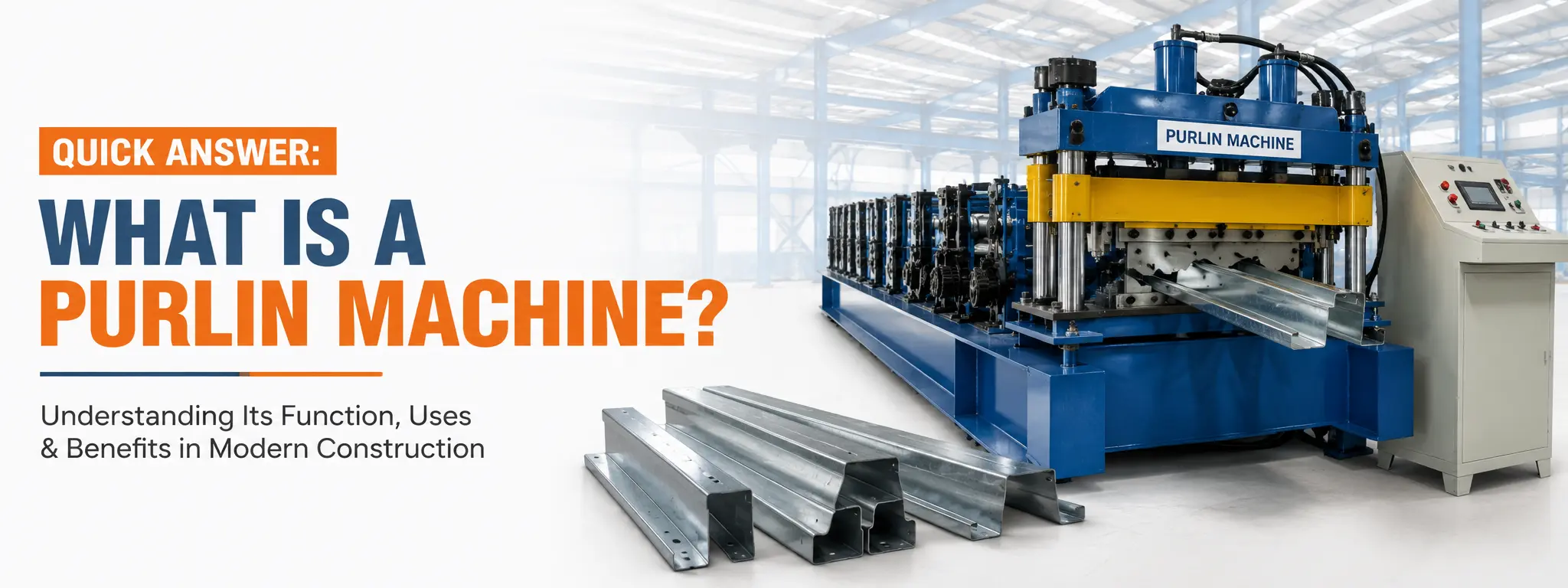
Quick Answer: What Is a Purlin Machine?
A purlin machine, also called a roll forming machine, converts flat steel coil into structural C, Z, or U sections used to support roof sheeting and wall cladding in industrial and commercial buildings. The coil passes through a sequence of forming rollers that gradually bend it into the final profile, after which a cut-to-length unit trims each piece to the required size. Purlin machines are used by fabricators, PEB (pre-engineered building) contractors, and steel structure manufacturers who need a consistent, repeatable supply of roofing support members without manual cutting or welding.
Key Takeaways
- A purlin machine roll-forms C, Z, or U sections from coiled steel through a series of shaping rollers rather than cutting or pressing.
- Z sections are used where purlins need to overlap at supports for continuous spans; C sections are typically used at building ends or where overlap isn’t needed.
- Roll forming produces parts with tighter dimensional consistency than manual bending, which matters directly for roof sheeting alignment.
- Material thickness, coil width tolerance, and roller station count are the main factors that decide output quality.
- Purlin sizing should follow structural design load, not just what a machine happens to produce.
- Site-level installation problems (bowing, twist, inconsistent hole spacing) usually trace back to either poor coil quality or a machine that hasn’t been correctly calibrated for the ordered thickness.
- Buyers evaluating a purlin machine manufacturer in India should ask about roller material, gearbox type, and after-sales support before price.
What Is a Purlin, and Why Does the Section Shape Matter?
Purlins are the horizontal structural members that run across roof trusses or rafters, carrying the load of the roof sheeting down to the main frame. In pre-engineered steel buildings, warehouses, industrial sheds, and large-span commercial structures, purlins are almost always cold-formed C or Z sections rather than hot-rolled beams, because roll forming is faster and more economical at the thicknesses typically required (1.5mm to 3mm).
The section shape isn’t cosmetic — it changes how the structure behaves:
- C-section purlins have a symmetrical channel profile. They’re commonly used at gable ends, eave struts, or in shorter spans where sections don’t need to overlap.
- Z-section purlins have an asymmetrical, sloped-flange profile designed so one purlin can nest into the next at a support point. This overlap, called “sleeving,” lets a continuous run of purlins act structurally as one longer member, which is why Z sections dominate in multi-bay industrial sheds with long roof runs.
- U-section purlins are less common structurally but are widely used for door and window framing, wall girts, and light-duty framing applications.
A site engineer choosing between the two is really choosing between simplicity (C) and structural continuity across bays (Z). Getting this wrong at the design stage means either wasted steel or an underperforming roof frame.
How a Purlin Roll Forming Machine Actually Works?
Understanding the process helps a buyer evaluate machines on substance rather than just price:
- De-coiling: Steel coil is loaded onto a de-coiler and fed into the machine at a controlled tension. Uneven tension at this stage is one of the most common causes of camber (side-bow) in the finished purlin.
- Roll forming stations: The flat strip passes through a series of roller stations — typically 12 to 18 for a C/Z purlin line — each one incrementally bending the metal closer to its final profile. Trying to form the full bend in fewer stations increases stress on the steel and raises the risk of surface cracking or spring-back.
- Punching (if fitted): Many purlin lines include an in-line punch unit that creates bolt holes for sleeve connections before the final profile is formed, since post-forming punching on a closed section is far harder to do accurately.
- Cut-to-length: A flying shear or hydraulic cutter trims each purlin to the programmed length while the line keeps running, rather than stopping for every cut.
- Stacking: Finished purlins are collected on an output table or automatic stacker, ready for bundling and dispatch to site.
The entire line is usually run through a single PLC control panel, where the operator sets target length, punch position, and quantity — this is what allows one operator to run repeat batches without manually adjusting every station.
C vs Z Purlin Production: A Comparison
|
Factor |
C-Section Production |
Z-Section Production |
|
Roller tooling |
Symmetrical die set |
Asymmetrical, sloped-flange die set |
|
Typical use |
Eave struts, gable ends, shorter spans |
Continuous multi-bay roof runs |
|
Sleeving/overlap capability |
Not designed for overlap |
Designed for overlap at supports |
|
Tooling changeover |
Simpler, fewer adjustment points |
Requires more precise roller alignment |
|
Common thickness range |
1.5mm – 3mm |
1.5mm – 3mm |
|
Structural role |
Standalone member |
Can act as a continuous beam across bays |
Where Purlin Machines Fit Into Roofing and Structural Projects?
On a live industrial shed or warehouse project, the purlin isn’t an isolated component — it interacts with the primary frame, the roof sheeting, and the wind/seismic bracing system. A few things site teams consistently run into:
- Span vs. thickness trade-offs. A longer bay spacing means either a heavier gauge purlin or closer purlin spacing — this is a structural design decision, not a machine setting, and should come from the structural consultant’s calculations, not be reverse-engineered from whatever the machine is set up to run that week.
- Punch hole alignment. If bolt holes for sleeve connections aren’t positioned consistently across a batch, site crews lose time hand-drilling on scaffolding — a slow, costly fix compared to catching it at the punching stage.
- Coil quality upstream. A well-calibrated purlin machine still can’t correct for an inconsistent coil. Camber, thickness variation, or poor galvanizing on the input coil shows up directly in the finished purlin.
These are the kinds of coordination points that come up repeatedly on turnkey structural steel projects, where the roll forming line, the punching sequence, and the final site erection all have to line up with the structural drawing rather than be treated as separate steps.
Selection Considerations for Buyers
When evaluating a purlin machine manufacturer in India, a few practical checkpoints matter more than headline speed figures:
- Number of forming stations: More stations generally means gentler, more accurate forming, especially for thicker gauge material.
- Roller material and hardness: Rollers should be hardened and precision-ground; softer rollers wear faster and gradually distort the profile over the life of the tooling.
- Gearbox and drive type: Chain-driven vs. gear-driven stations affect long-term maintenance load and synchronization accuracy between stations.
- Punching flexibility: Confirm whether the punch unit supports the hole patterns your projects actually use, rather than a fixed single pattern.
- PLC and changeover time: For fabricators running multiple profiles or sizes, quick tooling changeover directly affects daily output.
- After-sales and spares availability: Roll forming lines run for years; the ability to get replacement rollers, bearings, and PLC support locally matters as much as the initial machine spec.
Cost Factors to Understand
Purlin machine pricing varies with automation level, number of forming stations, punching capability, and cutting mechanism (mechanical vs. hydraulic flying shear). Buyers should treat cost per machine and cost per ton of finished purlin as two separate calculations — a higher upfront machine cost with better roller durability and lower scrap rate can work out cheaper over a production run than a lower-priced line with frequent tooling wear. It’s also worth budgeting separately for installation, operator training, and commissioning, since these affect how quickly a new line reaches its rated output.
Safety Considerations
Roll forming lines involve moving coil under tension, rotating rollers, and in-line cutting or punching operations. Standard safety practice includes guarding at all roller stations, emergency stop access at multiple points along the line, proper de-coiler mounting to prevent coil slippage, and trained operators for coil loading, which is one of the higher-risk manual steps in the process. Machines used for export or projects with international clients are increasingly expected to carry relevant safety certification, such as CE marking, alongside standard quality certifications like ISO 9001.
Industry Trends and Future Outlook
Demand for C and Z purlins continues to track the growth of pre-engineered steel building (PEB) construction in India, which is expanding across warehousing, logistics parks, and light industrial sheds. On the manufacturing side, the trend is toward higher automation — PLC-controlled length and punch programming, automatic stacking, and quicker changeover between profile sizes — driven by fabricators who need to run shorter batches of varying sizes rather than one continuous long run. Quality expectations have also risen, with more buyers asking for documented tolerances and certification rather than relying on visual inspection alone.
Frequently Asked Questions
What is a purlin machine?
A purlin machine is a roll forming machine that shapes flat steel coil into C, Z, or U section purlins used as roof and wall support members in steel-frame buildings.
How does a purlin machine work?
It feeds steel coil through a sequence of forming rollers that gradually bend it into the target profile, then punches (if required) and cuts each piece to length using an in-line cutting unit.
What’s the difference between C and Z purlins?
C-section purlins are symmetrical and typically used at building ends or shorter spans. Z-section purlins have an offset profile that allows overlap (“sleeving”) between spans, making them suited to continuous multi-bay roofs.
What thickness range can a purlin machine handle?
Most industrial purlin lines are built to run coil thickness roughly between 1.5mm and 3mm, though the exact range depends on the machine’s roller and motor specification.
Are purlin machines suitable for large-scale projects?
Yes — roll forming is specifically suited to high-volume, repeat production, which is why it’s the standard method for purlins on large PEB and warehouse projects rather than manual cutting and bending.
What are the main limitations of a purlin machine?
Roll forming is efficient for standard profile shapes at set thickness ranges, but custom or one-off profile changes require re-tooling, which takes time and isn’t cost-effective for very small batches.
How much does a purlin machine cost?
Cost depends on the number of forming stations, punching capability, cutting mechanism, and automation level. It’s best evaluated alongside expected scrap rate and tooling life rather than sticker price alone.
Which industries use purlin machines?
Steel structure fabricators, PEB contractors, warehouse and logistics park builders, and industrial shed manufacturers are the primary users.
What should buyers check before selecting a purlin machine manufacturer in India?
Roller hardness and material, number of forming stations, gearbox type, punching flexibility, PLC control quality, and the availability of after-sales spares and support.
Can a purlin machine produce both C and Z sections on one line?
Some lines are built with interchangeable roller sets that allow both profiles on the same machine, while others are dedicated to a single profile. This should be confirmed at the specification stage based on production needs.
Does purlin thickness affect roof design?
Yes — purlin gauge and spacing are structural decisions tied to span length and roof load, and should be confirmed by a structural consultant rather than set by machine convenience.
What causes bowing or twist in finished purlins?
Usually inconsistent de-coiler tension, uneven input coil quality, or a roller station that isn’t correctly calibrated for the material thickness being run.
Is punching done before or after roll forming?
Hole punching is typically done in-line before the final profile bend, since punching a closed C or Z section afterward is far harder to align accurately.
What certifications should a purlin machine manufacturer hold?
ISO 9001 for quality management is standard; CE certification is relevant for manufacturers supplying international or export markets.
How is a purlin machine different from a general roll forming machine?
“Roll forming machine” is the broader category; a purlin machine is a roll forming line specifically tooled for C, Z, or U structural profiles used in roofing and wall systems, as opposed to profiles for other applications like decking or cladding.
About This Guide
This guide draws on Nirmal Overseas Private Limited’s background as a purlin machine manufacturer in India, part of a broader turnkey equipment portfolio that includes tube mills, slitting lines, and API pipe mills supplied to fabricators across India and internationally. Site-level considerations referenced here — punch alignment, coil quality, and sleeving connections — reflect the kind of coordination questions that come up on structural steel and roofing projects where purlin production is one part of a larger fabrication workflow.