
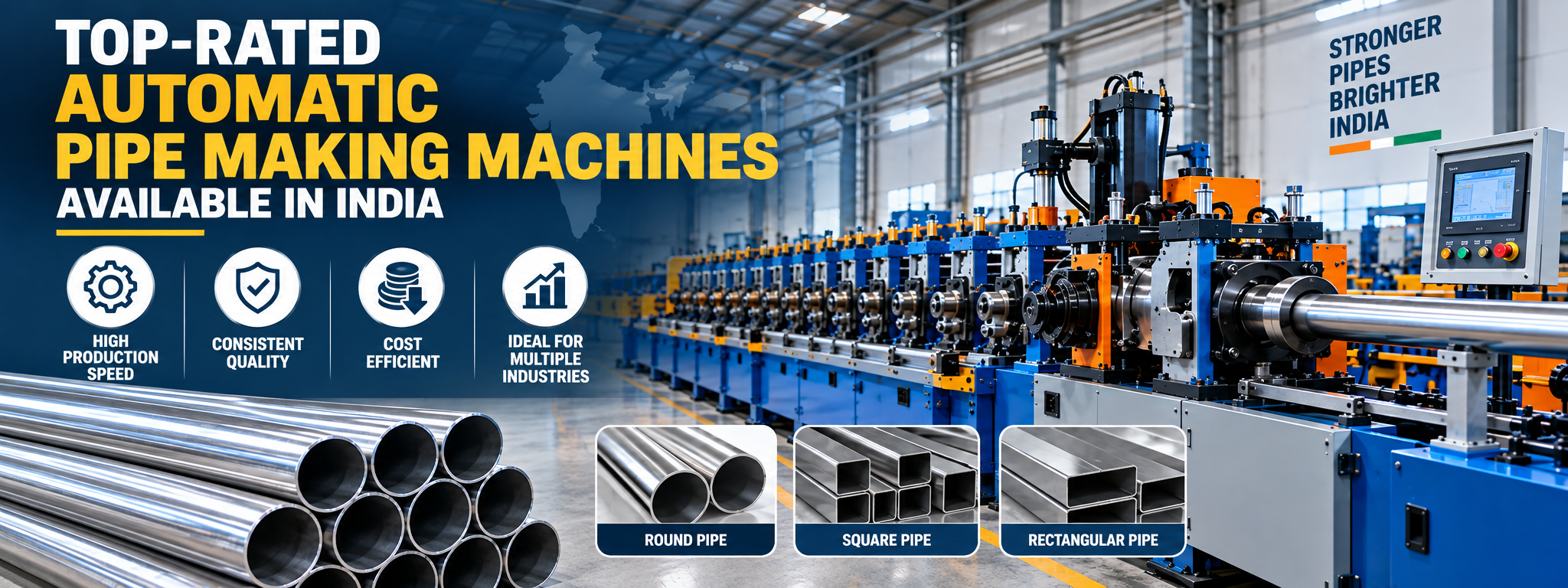
An automatic pipe making machine is industrial equipment that converts flat steel strip into finished round, square, or rectangular pipes through a continuous, PLC-controlled sequence of forming, welding, sizing, and cutting — with minimal manual intervention at each stage. It’s the core equipment behind most steel pipe production lines in India today.
This article explains how these machines work, the different types available, and the features that define a well-built, reliable machine.
What Is an Automatic Pipe Making Machine?
An automatic pipe production machine — commonly called a tube mill — takes coiled steel strip and shapes it into a continuous tube using a series of forming rollers, welds the seam, and sizes and cuts the finished pipe to length. What makes it “automatic” is the use of PLC (Programmable Logic Controller) systems that manage strip feeding speed, roller positioning, and welding parameters together, instead of requiring an operator to adjust each one manually as the line runs.
This automation matters because pipe dimensions and weld quality depend on multiple variables staying synchronized in real time — line speed, roll pressure, and welding current all need to move together. A manual line depends on operator skill to keep these in balance; an automatic line does it electronically, which is why automatic machines generally produce more consistent output over long runs. This is one of the main reasons most modern steel pipe manufacturing plants in India are built around automatic lines rather than manual ones.
How an Automatic Pipe Manufacturer Machine Works?
The production sequence inside an automatic pipe manufacturer machine follows a fixed order, regardless of the final pipe shape:
- Uncoiling — the steel coil is mounted on a decoiler and fed into the line
- Strip accumulation — an accumulator stores extra strip so the line can keep running while a new coil is loaded, avoiding stoppages
- Forming — a series of roller stands progressively curls the flat strip into a tubular shape, one stage at a time
- Welding — the two edges of the formed tube are joined, most commonly through ERW (Electric Resistance Welding) or high-frequency induction welding
- Bead trimming — the raised weld seam left by the welding process is shaved off internally and externally for a smooth finish
- Sizing — the tube passes through sizing rolls that bring it to the exact final diameter and wall thickness
- Cutting — a flying saw or cold cut-off unit cuts the continuous tube into fixed lengths without stopping the line
In fully automatic setups, sensors monitor thickness and weld quality as the pipe moves through the line, flagging inconsistencies immediately rather than only during post-production inspection.
Types of Automatic Pipe Production Machines Available in India
Machine selection depends primarily on the pipe shape, size range, and material being produced. India’s pipe manufacturing industry uses several distinct machine types, each suited to a different product category.
1. ERW Pipe Mills
ERW (Electric Resistance Welded) pipe mills are the most widely installed automatic pipe production machines in India. They form round pipes by curling flat strip through progressive roller stands and welding the seam using electric resistance heat generated by passing current directly through the strip edges at the point of contact.
How they operate: The strip passes through a breakdown section that begins the curling process, then through fin-pass rolls that bring the edges close together, followed by the weld box where induction or contact welding fuses the seam. After welding, the pipe moves through sizing rolls and a straightener before final cutting.
Typical output: Round pipes ranging from small-diameter tube (used in furniture and fencing) up to larger structural pipe, depending on the specific mill’s roll tooling.
Common applications: Plumbing pipe, structural pipe for construction framing, fencing tube, and general engineering pipe — ERW mills cover the broadest range of everyday pipe applications in India.
2. Square and Rectangular Tube Mills
These machines produce hollow structural sections used across furniture manufacturing, metal fabrication, and construction framing. There are two common approaches:
- Round-then-reshape: the strip first forms into a round tube, is welded, and then passes through a separate box-forming section that reshapes it into a square or rectangular profile
- Direct forming (DFT): newer systems form the square or rectangular profile directly from flat strip without first creating a round tube, reducing the number of forming stages and edge preparation steps involved
Typical output: Square and rectangular hollow sections in a range of wall thicknesses, depending on tooling.
Common applications: Furniture frames, door and window sections, purlins, and general fabrication work where a flat-sided profile is structurally or aesthetically preferable to round tube.
3. Slitting Lines
A slitting line isn’t a forming machine on its own, but it’s a critical part of most automatic pipe production setups. It takes a wide master coil of steel and cuts it into narrower strips of a specific width, matched to what a downstream tube mill requires.
How they operate: The coil passes through an uncoiler, then between a set of circular cutting blades (the slitter head) that divide it into multiple strips simultaneously, and finally onto a recoiler that winds each strip into its own coil, ready to feed a tube mill.
Why plants use them: Buying wider master coils and slitting in-house is typically more cost-efficient than sourcing pre-slit strips, and it gives a plant direct control over strip width tolerance, which affects forming and weld quality downstream.
4. High-Frequency Welded Pipe Mills
High-frequency (HF) induction welding mills use an induction coil to heat the strip edges without direct electrical contact, unlike standard ERW resistance welding. The induced current concentrates at the point where the edges meet, allowing for a fast, controlled weld.
How they differ operationally: Because there’s no physical electrode contact at the weld point, HF mills generally support higher line speeds and reduce the maintenance issues associated with electrode wear in contact-based ERW welding.
Typical output: Thinner-gauge round and shaped pipe produced at higher speeds than standard ERW lines can typically achieve.
Common applications: High-volume production runs where speed and consistent weld quality on thinner material both matter, such as large-scale furniture tube or automotive-grade tubing.
5. Spiral Pipe Mills
Spiral pipe mills produce large-diameter pipe using a fundamentally different feed method — the strip is fed into the mill at an angle rather than straight through, causing it to wind into a spiral or helical shape as it forms into a tube. The seam is welded along this spiral path rather than in a single straight line.
How they differ operationally: Because the strip is fed diagonally, spiral mills can produce a wider range of pipe diameters from a single strip width than straight-seam mills, which are limited by the strip width itself.
Typical output: Large-diameter pipe, often exceeding what straight-seam ERW or HF mills can efficiently produce.
Common applications: Water transmission pipelines, large infrastructure projects, and piling pipe used in construction.
Key Features of a Well-Built Automatic Pipe Production Machine
Regardless of machine type, a handful of design and control features consistently determine how reliably a machine performs in continuous production:
- PLC-synchronized control — welding current, roll speed, and cut-off length adjust together automatically as line speed changes
- Quick-change roll tooling — allows a plant to switch between pipe sizes without extended downtime
- Inline quality sensors — detect thickness or weld irregularities during production rather than only at final inspection
- Stable sizing and straightening sections — directly affect whether finished pipe holds dimensional tolerance consistently
- Durable forming rolls and dies — wear resistance in the tooling affects how long a machine holds tight tolerances between maintenance cycles
Manual vs Automatic Pipe Making: What’s the Difference
A manual or semi-automatic pipe making line requires operators to adjust roller gaps, monitor weld quality visually, and manually trigger cutting at each size change. An automatic line manages these functions electronically through a PLC system, which reduces the dependency on operator judgment during continuous runs.
The practical difference shows up most clearly in two areas: consistency, since automatic control keeps welding and forming parameters synchronized even as line speed changes, and changeover time, since automatic systems are typically built with quick-adjust tooling designed for frequent size switches. Manual lines can still produce quality pipe, but output consistency depends more heavily on operator experience and attentiveness.
FAQs
What is an automatic pipe production machine used for?
It’s used to convert flat steel strips into round, square, or rectangular pipe for applications like plumbing, structural framing, furniture, fencing, and infrastructure pipelines, through a continuous PLC-controlled forming and welding process.
What is the difference between ERW and high-frequency welded pipe mills?
ERW mills weld the seam using direct electrical contact at the strip edges, while HF mills use induction heating without direct contact, which generally allows for higher line speeds and less electrode wear.
Why does an automatic pipe making machine need a strip accumulator?
An accumulator stores extra strips so the line can keep running while a new coil is loaded onto the decoiler, preventing the machine from stopping every time one coil runs out.
How is a direct forming (DFT) machine different from a regular square tube mill?
A regular square tube mill first shapes the strip into a round pipe and then reshapes it into a square or rectangular profile in a separate step. A direct forming (DFT) machine skips that round stage and shapes the square or rectangular profile straight from the flat strip, which means fewer forming steps.
What’s the difference between a straight-seam mill and a spiral pipe mill?
Straight-seam mills feed strip directly through the line to form a straight weld seam, while spiral mills feed strip at an angle, allowing large-diameter pipe to be produced from narrower strip widths.
What role does the PLC play in an automatic pipe production machine?
The PLC is the machine’s control system. It keeps roll speed, welding power, and cutting length working together automatically as the line runs, so an operator doesn’t have to adjust each one by hand every time the speed changes.
Conclusion
An automatic pipe making machine brings together forming, welding, sizing, and cutting into a single continuous, PLC-controlled process — and the specific type, whether ERW, square/rectangular, high-frequency welded, or spiral, depends entirely on the pipe shape and size range being produced. Understanding how each type works and what separates a well-built machine from a basic one is the foundation for evaluating any pipe production setup. Nirmal Overseas Private Limited has been engineering tube mills and pipe manufacturing machinery built around exactly these principles, so plants get consistent, reliable output regardless of the pipe type they run.
If you have questions about any of the machine types covered here, or want to talk through your specific production requirements, get in touch with our team.