
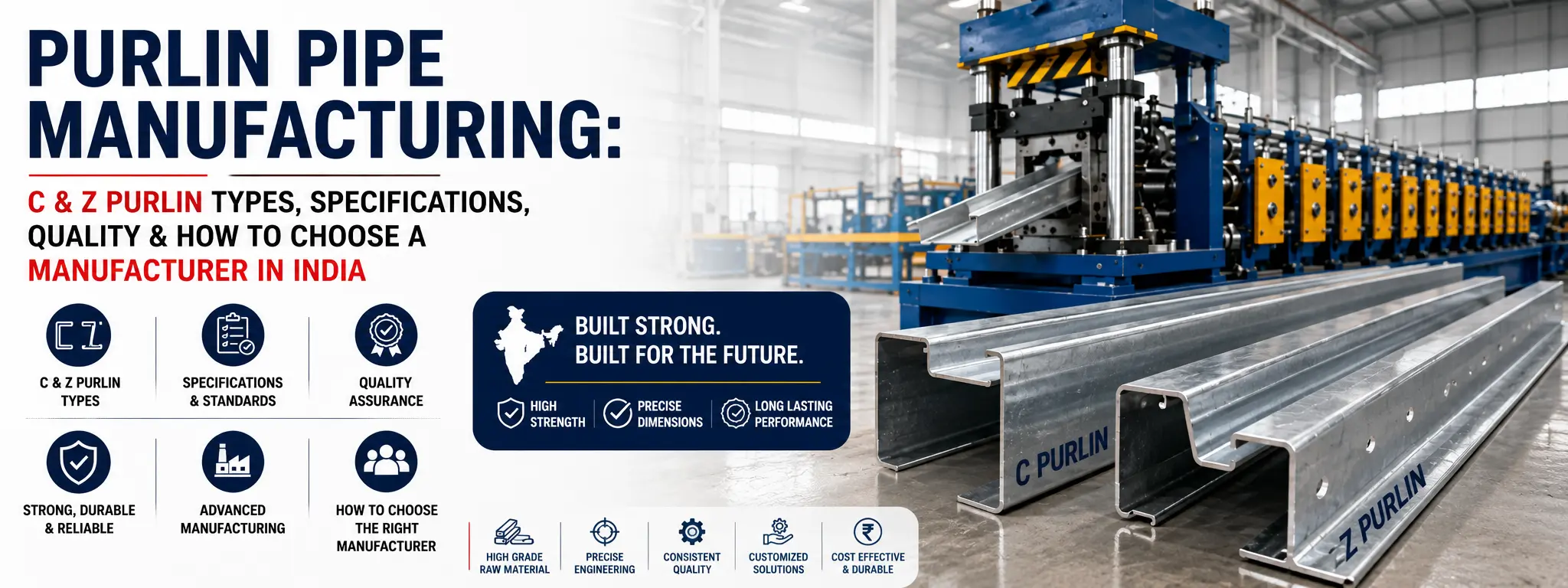
Purlins are an important part of modern steel construction. They connect the primary structural frame with roofing and wall systems, helping transfer loads while providing a practical framework for fixing roof and wall cladding. In industrial sheds, warehouses, pre-engineered buildings (PEBs), commercial structures, and other steel-frame applications, cold-formed C and Z sections are widely used because they can provide the required structural performance without the weight associated with heavier conventional sections.
For buyers, however, choosing the right purlin pipe is about more than selecting a C or Z profile. Material quality, thickness, dimensions, hole positioning, straightness, surface protection, manufacturing consistency, and compliance with project requirements all affect the finished product.
The manufacturing equipment behind these sections is equally important. A properly configured purlin production line helps manufacturers produce repeatable profiles and maintain consistent dimensions across production batches.
This guide explains purlin pipes from a product and manufacturing perspective, including their types, materials, specifications, quality checks, applications, and what to consider when selecting a purlin pipe manufacturer in India or a purlin machine manufacturer in India.
What Is a Purlin Pipe?
In structural steel applications, the term purlin pipe is commonly used for cold-formed open structural sections manufactured from steel coil. Unlike conventional round pipes or hollow tubes, these products generally have open C, Z, or U-type profiles.
Purlins are installed horizontally between the main structural members of a building. Their primary role is to provide support for roofing sheets, wall cladding, and associated structural components.
Common applications include:
- Pre-engineered buildings
- Industrial sheds
- Warehouses
- Manufacturing facilities
- Commercial buildings
- Roofing systems
- Wall-girt systems
- Agricultural and utility structures
- Steel-framed buildings
The exact purlin profile and dimensions should be selected according to the structural design, loading conditions, span, spacing, connections, and applicable engineering requirements.
C Purlin Pipe
A C purlin has a channel-like profile with a web, flanges, and, depending on the design, return lips.
C sections are often selected for applications where overlapping adjoining purlins is not required or where the structural configuration calls for individual members.
Typical applications can include:
- Building ends
- Eave areas
- Wall framing
- Shorter structural spans
- Secondary framing applications
The appropriate C-section dimensions should always be determined from the project’s structural requirements rather than selected solely according to availability.
Z Purlin Pipe
A Z purlin has an offset profile that allows adjacent sections to overlap at supports. This characteristic makes Z sections particularly useful in many multi-bay steel buildings where sleeved connections are incorporated into the structural design.
Potential applications include:
- Industrial warehouses
- Large steel sheds
- Multi-bay PEB structures
- Long roof runs
- Continuous secondary framing systems
The overlap arrangement, connection details, and member dimensions should be established by the structural design.
C Purlin vs Z Purlin Pipe
Factor | C Purlin | Z Purlin |
Basic profile | C-shaped open section | Z-shaped open section |
Common use | Ends, framing and applications without sleeving | Multi-bay and overlapping applications |
Overlapping | Generally not intended for conventional sleeving | Can be designed for overlapping/sleeving |
Installation | Straightforward individual-member installation | Requires attention to orientation and overlap |
Typical applications | Eaves, walls, ends and secondary framing | Continuous roof runs and multi-bay structures |
Selection | Based on structural design | Based on structural design and connection arrangement |
Neither profile is universally better. The correct choice depends on the building’s structural design and intended application.
How Are Purlin Pipes Manufactured?
Manufacturing a purlin is more than simply bending a sheet of steel. A consistent finished section requires controlled material feeding, profile formation, dimensional control, cutting, and inspection.
A typical production sequence can be represented as:
Steel Coil → Material Inspection → Decoiling → Leveling/Feeding → Profile Forming → Punching → Cutting → Inspection → Bundling → Dispatch
Each stage contributes to the quality of the finished purlin.
1. Steel Coil Selection
Production starts with the selection of suitable steel coil.
Important material characteristics include:
- Steel grade
- Material thickness
- Coil width
- Surface condition
- Mechanical properties
- Coating requirements
- Dimensional consistency
The input material should be compatible with the intended purlin profile and the forming equipment.
Using inconsistent input material can create problems later in production, even when the forming line itself is correctly configured.
2. Coil Preparation
The steel coil is loaded into the production line and prepared for controlled feeding.
The objective is to maintain stable material movement throughout the production process.
Coil condition matters because variation in material width, thickness, flatness, or mechanical properties can affect the consistency of the finished profile.
3. Profile Forming
The flat steel strip is progressively formed into the required C, Z, or other open profile.
Rather than creating the entire profile in a single operation, roll forming gradually changes the geometry as the material passes through the forming system.
The final result depends on:
- Material characteristics
- Tooling configuration
- Profile dimensions
- Machine alignment
- Forming setup
- Production parameters
For manufacturers supplying structural projects, repeatability is particularly important because hundreds or thousands of members may need to match the same approved dimensions.
4. Punching and Connection Preparation
Many purlins require holes for structural connections.
Depending on the production line and project requirements, punching can be integrated into the manufacturing process.
Hole position is important because inaccurate punching can create difficulties during site assembly.
For project-specific production, the manufacturer should work from approved drawings or clearly defined hole patterns rather than relying on assumptions.
5. Cutting to Length
After forming, purlins are cut to the required lengths.
Cutting requirements may vary between projects. Some applications require standard lengths, while others require members manufactured according to project drawings.
Consistent cutting helps reduce site modifications and unnecessary material waste.
6. Inspection and Bundling
The final stage is quality inspection and preparation for dispatch.
Finished purlins can be checked for:
- Overall length
- Profile dimensions
- Material thickness
- Straightness
- Twist
- Hole positioning
- Surface condition
- Coating quality
- Edge condition
After inspection, members can be bundled and identified according to size, profile, project, or other production requirements.
What Raw Materials Are Used for Purlin Pipes?
The choice of raw material directly influences the performance, durability, weight, and suitability of a purlin for a particular project.
Mild Steel
Mild steel is widely used in structural fabrication because it offers a practical combination of strength, formability, availability, and cost.
The exact grade should be selected according to the engineering requirements of the project.
High-Strength Steel
High-strength grades may be considered where structural requirements call for higher strength while controlling member weight.
However, material selection should be based on engineering calculations and applicable standards rather than simply choosing the highest available strength.
Galvanized Steel
Galvanized steel has a protective zinc coating designed to improve resistance against corrosion.
It can be useful for applications where exposure to moisture or corrosive conditions is a concern.
The appropriate coating specification depends on the service environment and project requirements.
Coated Steel
Other coated steel products may also be used depending on the application.
When selecting material, buyers should consider not only the base steel grade but also:
- Coating type
- Coating thickness
- Environmental exposure
- Expected service conditions
- Fabrication requirements
Purlin Pipe Sizes, Thickness and Profile Dimensions
There is no single universal purlin size suitable for every building.
A purlin’s dimensions are determined by factors such as:
- Structural span
- Roof loading
- Wind loading
- Snow loading where applicable
- Purlin spacing
- Building geometry
- Connection design
- Material strength
- Deflection requirements
- Project specifications
Common dimensional parameters include:
Web Depth
The web is the main vertical portion of the section. Its depth is an important part of the overall profile geometry.
Flange Width
The flange extends from the web and contributes to the section’s structural characteristics and connection arrangement.
Lip Dimension
Some C and Z purlins include return lips that influence section stiffness and overall profile geometry.
Material Thickness
Thickness affects the weight, strength, forming requirements, and structural performance of the finished section.
Length
Purlins may be produced in standard or project-specific lengths depending on manufacturing capability and project requirements.
A manufacturer should therefore work from the customer’s approved profile drawing or structural specification whenever custom dimensions are required.
What Determines the Quality of a Purlin Pipe?
A purlin can look acceptable visually and still have dimensional or manufacturing inconsistencies that cause problems during installation.
Important quality parameters include:
Consistent Profile Dimensions
The web, flange, lip, and overall section dimensions should remain within the specified tolerance throughout the production batch.
Uniform Material Thickness
Material thickness should correspond to the ordered specification.
Unexpected variation can affect both structural performance and weight calculations.
Straightness
Purlins should maintain the required straightness so that they can be positioned and connected properly during installation.
Hole Position Accuracy
For punched purlins, hole location is critical.
Even relatively small inconsistencies can create difficulties when connecting members on site.
Clean Cut Ends
Cutting should produce ends suitable for handling and installation without unnecessary deformation or damage.
Surface and Coating Quality
For galvanized or coated material, the surface should be inspected for visible defects, damage, or handling-related deterioration.
Batch-to-Batch Consistency
A professional manufacturing process should aim for repeatability, particularly when large quantities are produced for a single project.
How to Check Purlin Pipe Quality Before Buying
A buyer should not evaluate purlin pipes only on price per piece or per tonne.
Before placing a large order, consider the following checks.
Check the Material Specification
Confirm:
- Steel grade
- Thickness
- Coating
- Material standard
- Required documentation
Verify Profile Dimensions
Compare the supplied profile with the approved drawing or purchase specification.
Check the:
- Web
- Flanges
- Lips
- Overall depth
- Overall width
Inspect Straightness
Look for visible bowing, twisting, or deformation.
Long structural members should be checked appropriately rather than judged only from a small sample.
Check Punch-Hole Positions
Where punched connections are required, verify that:
- Hole diameter is correct
- Hole spacing is correct
- Hole location matches the drawing
- The hole pattern is consistent across the batch
Inspect Surface Condition
For coated or galvanized material, inspect the surface for damage and obvious inconsistencies.
Verify Length
Check whether supplied lengths correspond to the approved order.
Ask for Quality Documentation
Depending on the project, buyers may request relevant material certificates, inspection records, dimensional reports, or other documentation.
The exact documentation should match the project’s contractual and engineering requirements.
Where Are Purlin Pipes Used?
Purlins are used across a wide range of steel construction applications.
Pre-Engineered Buildings
PEBs are one of the major applications for cold-formed secondary structural members.
Purlins connect the roof system to the primary frame and provide a suitable support arrangement for roofing components.
Industrial Warehouses
Warehouses often require efficient structural systems capable of covering large floor areas.
C and Z purlins can form part of the secondary framing system used to support roof and wall cladding.
Factory Sheds
Manufacturing and industrial sheds frequently use steel framing because of construction speed and structural flexibility.
Purlins contribute to the roof and wall framing arrangement.
Commercial Buildings
Steel-framed commercial structures can also use cold-formed sections where they meet the project’s engineering requirements.
Agricultural Structures
Depending on design and environmental conditions, purlins can be used in agricultural and utility structures.
Roofing and Wall Cladding Systems
Purlins and girts provide intermediate support for roofing and wall-cladding systems, helping transfer loads to the primary structure.
Purlin Pipes for Different Project Requirements
Different projects require different approaches to purlin selection.
For Large Warehouses
The structural engineer may specify particular C or Z sections based on bay spacing, roof loading, and connection requirements.
For Industrial Sheds
Material thickness, corrosion protection, profile dimensions, and fabrication requirements may all influence the specification.
For Multi-Bay Buildings
Z sections may be considered where the structural design incorporates overlapping or sleeved members.
For Corrosive Environments
Material protection becomes especially important. Galvanized or appropriately coated steel may be considered according to environmental conditions.
For Lightweight Structures
Higher-strength material or optimized profiles may be considered where the structural design aims to balance strength and weight.
In every case, the final section should be selected through proper structural design rather than simply choosing the lightest or most economical-looking option.
How to Choose a Purlin Pipe Manufacturer in India
Selecting a reliable purlin pipe manufacturer in India requires more than comparing quotations.
A buyer should assess the manufacturer’s technical capability, quality-control process, production consistency, and ability to meet project-specific requirements.
1. Manufacturing Capability
Ask what profiles, sizes, thicknesses, and materials the manufacturer can produce.
2. Profile Customization
If your project requires non-standard dimensions, confirm whether the manufacturer can work from approved drawings and provide the required tooling or production arrangement.
3. Material Quality
Understand where the input steel comes from and what material specifications are supported.
4. Dimensional Control
Ask how profile dimensions, thickness, length, and hole positioning are checked during production.
5. Production Capacity
For large projects, confirm whether the manufacturer can maintain the required production volume within the project schedule.
6. Quality Documentation
Depending on the project, determine what inspection and material documentation can be supplied.
7. Packaging and Identification
Proper bundling and identification can simplify unloading, storage, and installation at the project site.
8. Delivery Capability
Consider production lead time, transportation planning, delivery location, and the manufacturer’s ability to coordinate with project schedules.
9. Technical Understanding
A manufacturer should be able to understand the profile drawings and production requirements rather than simply supplying a generic section.
How a Purlin Machine Manufacturer in India Supports Purlin Production
There is an important distinction between purchasing finished purlins and establishing a purlin production facility.
A company looking to manufacture C, Z, or U profiles internally needs suitable roll-forming equipment and supporting systems.
This is where a purlin machine manufacturer in India becomes relevant.
When evaluating machinery, consider:
- Required profile range
- Material thickness capability
- C/Z/U profile requirements
- Tooling configuration
- Punching requirements
- Cutting arrangement
- Automation level
- Production speed
- Changeover requirements
- Control system
- Installation and commissioning
- Operator training
- Spare-parts availability
- Technical support
Nirmal Overseas offers open-profile/purlin machinery for C, U and Z sections as well as door and window profiles. Its current product information highlights easy operation, consistent performance, compact design, and lower power consumption.
For manufacturers planning a new production line, the machine should be selected around the actual product mix rather than around a headline production speed.
Purlin Pipe Manufacturer vs Purlin Machine Manufacturer
These two terms are often confused, particularly when researching suppliers online.
Type of Company | Primary Offering | Typical Buyer |
Purlin pipe manufacturer | Finished C/Z/U structural sections | Contractors, PEB companies, fabricators |
Purlin machine manufacturer | Machinery for producing purlins | Steel processors and manufacturers |
Steel fabricator | Fabricated structural components | Construction and industrial projects |
PEB contractor | Complete building/structural solution | Industrial and commercial clients |
The distinction matters because the purchasing process is completely different.
Someone building a warehouse may need finished purlins.
A steel manufacturer expanding its production facility may instead need a purlin machine.
A machine manufacturer such as Nirmal Overseas serves the latter requirement by providing machinery and related engineering capabilities. Nirmal Overseas lists purlin/open-profile machines alongside tube mills, API pipe mills, slitting lines, galvanizing plants and other industrial equipment.
What Should You Ask a Purlin Manufacturer Before Placing an Order?
Before confirming a purchase, buyers should establish the technical requirements in writing.
Useful questions include:
- What steel grade will be used?
- What material thickness is required?
- What C, Z, or U profile dimensions are available?
- Can the profile be manufactured according to project drawings?
- What length tolerance is maintained?
- Can holes be punched according to an approved hole pattern?
- What coating or galvanizing options are available?
- What quality documents will accompany the material?
- How will the purlins be bundled and identified?
- What is the expected production lead time?
- How will large-volume orders be scheduled?
- What inspection process is followed before dispatch?
These questions help turn a generic price comparison into a proper technical procurement evaluation.
Common Purlin Manufacturing Problems and What They Indicate
Manufacturing problems can often be traced to material, tooling, setup, or quality-control issues.
Uneven Profile Dimensions
If dimensions vary within the same production batch, the manufacturer should investigate material consistency, tooling condition, alignment, and machine setup.
Bowed Purlins
Bowing can affect installation and alignment. Possible contributing factors include material characteristics, feeding conditions, forming setup, or incorrect machine adjustment.
Twisted Sections
Twisting can create problems during erection and may indicate an issue with forming alignment or material behavior.
Incorrect Hole Position
Incorrect punching can cause connection problems on site. Hole patterns should therefore be verified against the approved production drawing.
Inconsistent Length
Variation in finished length can complicate installation and increase site modification work.
Damaged Coating
Damage to galvanized or coated surfaces can reduce the intended corrosion protection and should be assessed during quality inspection and handling.
The objective is not merely to identify defects after production but to establish a manufacturing process that minimizes them in the first place.
Why Manufacturing Equipment Matters to Purlin Quality
The finished purlin is only as consistent as the complete manufacturing process behind it.
A capable production line should be selected according to:
- Product profile
- Material characteristics
- Thickness range
- Required tolerances
- Production volume
- Punching requirements
- Cutting requirements
- Changeover requirements
Nirmal Overseas describes its purlin machine as an open-profile machine designed for C, U and Z sections as well as door and window profiles. The company’s wider engineering portfolio includes machinery for steel tube and pipe production, slitting, galvanizing, cutting and other industrial applications.
This broader equipment capability can be relevant for manufacturers looking to develop an integrated steel-processing setup rather than purchasing an isolated machine.
Why Choose Nirmal Overseas for Purlin Machine Solutions?
Nirmal Overseas Private Limited has been operating since 1983 and describes itself as an engineering company involved in manufacturing machinery and turnkey projects for steel tube, pipe, profile, and related applications. The company reports project execution in India and international markets and lists ISO and CE-related certifications on its company information.
Its machinery portfolio includes a dedicated purlin/open-profile machine for C, U and Z sections, along with equipment such as high-speed tube mills, API pipe mills, slitting lines, hot-dip galvanizing plants, cut-to-length lines, and burr-free cold-saw cutting systems.
For companies planning to manufacture structural profiles, the value of a machine supplier goes beyond the equipment itself. Machine configuration, application understanding, installation, commissioning, operator support, and long-term technical assistance can all influence the success of a production line.
Nirmal Overseas approaches these requirements as part of its broader machinery and turnkey engineering capabilities.
Frequently Asked Questions About Purlin Pipes
What is a purlin pipe used for?
A purlin pipe, generally referring to a cold-formed C, Z, or similar open structural section, is used as a secondary structural member to support roofing, wall cladding, and related building components in steel structures.
What is the difference between a C purlin and a Z purlin?
A C purlin has a channel-like profile, while a Z purlin has an offset Z-shaped profile. Z sections can be arranged with overlapping or sleeved connections where permitted by the structural design.
What steel is used to manufacture purlin pipes?
Purlins can be manufactured from different grades and types of structural steel depending on project requirements. The appropriate grade, thickness, and coating should be specified according to the structural design and applicable standards.
Are purlin pipes available in galvanized steel?
Yes, galvanized steel can be used for purlin applications where enhanced corrosion protection is required. The appropriate coating specification depends on the service environment and project requirements.
Can purlin pipes be manufactured in custom dimensions?
Many production systems can be configured for different profile dimensions. Custom production should be confirmed with the manufacturer based on the required profile drawing, material thickness, tooling, and production requirements.
How do I check the quality of a purlin pipe?
Check material thickness, profile dimensions, straightness, length, hole positioning, surface condition, coating quality, and relevant quality documentation. For project-critical applications, inspection should follow the approved technical specification.
How do I choose a purlin pipe manufacturer in India?
Look for a manufacturer with suitable material and profile capabilities, consistent dimensional control, quality inspection procedures, production capacity, technical expertise, and the ability to meet project-specific requirements.
What should I provide when ordering purlin pipes?
Provide the required profile, dimensions, material grade, thickness, lengths, quantity, coating requirements, hole patterns, applicable specifications, and project drawings wherever applicable.
What is a purlin machine?
A purlin machine is a roll-forming/open-profile production system used to manufacture C, Z, U, and other profiles from steel strip or coil.
What should I consider when choosing a purlin machine manufacturer in India?
Consider profile capability, material thickness range, tooling configuration, automation, punching and cutting systems, production requirements, machine build quality, commissioning support, training, spare parts, and after-sales technical support.
What is the difference between a purlin machine manufacturer and a purlin pipe manufacturer?
A purlin machine manufacturer supplies equipment used to manufacture structural profiles, while a purlin pipe manufacturer supplies the finished C, Z, U, or other structural sections.
Can one purlin machine produce different profiles?
Some machines can be configured or tooled for multiple profiles, depending on the machine design. The required profile range should be discussed with the manufacturer before equipment selection.
Final Thoughts
Choosing the right purlin pipe requires attention to the complete product—not just its profile name or price.
Material quality, thickness, dimensions, hole accuracy, straightness, coating, manufacturing consistency, and project-specific requirements all contribute to the suitability of a purlin for a structural application.
For companies purchasing finished structural sections, selecting a capable purlin pipe manufacturer in India can help ensure consistency across large production batches.
For companies intending to manufacture C, Z, or U profiles themselves, the decision shifts toward selecting the right purlin machine manufacturer in India and configuring the production line around the required profiles, materials, output, and quality requirements.
With its long-standing engineering background and portfolio of purlin/open-profile machinery, tube mills, slitting lines, galvanizing plants, and other steel-processing equipment, Nirmal Overseas provides machinery solutions for manufacturers looking to establish or expand profile-production capabilities.
If you are planning a purlin production line, share your required profile, material thickness, production capacity, and application with Nirmal Overseas to determine a suitable machine configuration.