

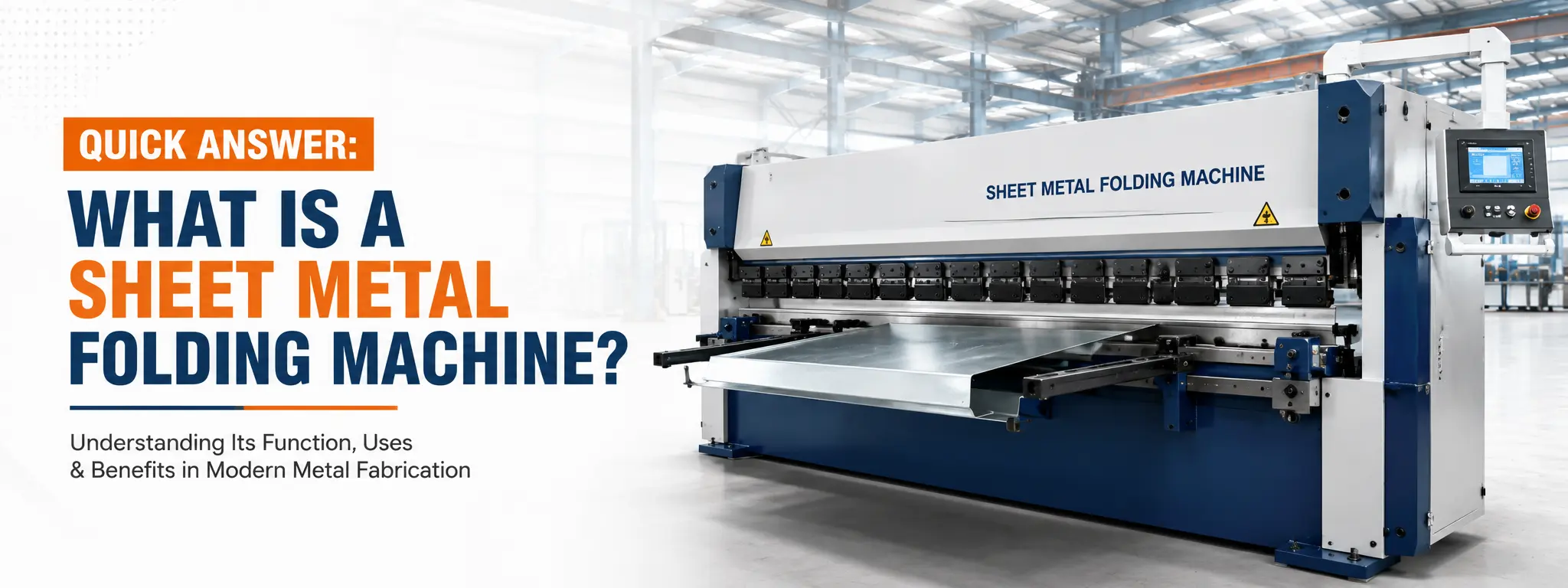
Quick Answer: What Is a Sheet Metal Folding Machine?
A sheet metal folding machine is an industrial machine used to bend flat metal sheets — including aluminium panels, mild steel, and stainless steel — into precise angles without stretching, tearing, or marking the surface. Unlike press brakes, folding machines clamp the sheet and fold it upward using a hinged beam, which makes them well suited for cladding panels, ductwork, enclosures, and architectural aluminium components where a clean, consistent edge matters. Folding machines are widely used by fabricators, panel manufacturers, and contractors who need repeatable bends across long sheet lengths without visible tool marks on the finished face.
Introduction
Anyone sourcing sheet metal fabrication equipment eventually runs into the same question: fold or bend? For fabricators working with aluminium panels, cladding sheets, and thin-gauge structural components, that decision affects surface finish, production speed, and long-term tooling cost. A sheet metal folding machine is often the better fit for pre-finished or coated aluminium sheet, where a press brake’s punch-and-die action risks marking the visible face.
This article looks at how folding machines actually work on the shop floor, where they fit against bending and slitting equipment, what drives project cost, and what site engineers and project managers should check before specifying one. As a sheet metal folding machine manufacturer in India, Nirmal Overseas works with fabricators across architectural cladding, ducting, and general sheet metal industries, and this piece draws on the practical questions that come up most often during those conversations — including how folding machine sourcing interacts with related equipment such as slitting lines, since many buyers evaluating a folding machine are also asking about slitting machine price as part of a full coil-processing setup.
Sheet Metal Folding Machines: Fundamentals
A folding machine works by clamping a metal sheet between an upper beam and a lower table, then lifting a hinged folding beam to bend the exposed portion of the sheet upward. The clamp holds the sheet stationary through the fold, which is what keeps the bend line straight even on long panels.
Two features distinguish folding machines from other bending equipment:
- No face-side tool marks. Because the folding beam contacts the underside of the bend, the visible face of the panel — critical for painted or anodised aluminium — stays clean.
- Long-length capability. Folding machines are commonly built in working lengths of 2 to 6 metres or more, which suits full-size cladding sheets that would otherwise need to be bent in sections.
Most machines used in India today are hydraulic, offering programmable bend angles and back-gauge positioning for repeat runs, though manual and mechanical folding units are still common for smaller job shops and lower-volume work.
Sheet Metal Folding vs Bending Machines
This is one of the most common questions from first-time buyers, and the honest answer is: it depends on the material and the finish requirement.
Factor | Sheet Metal Folding Machine | Press Brake (Bending Machine) |
Face-side marking | Minimal to none | Punch contact can mark coated/anodised surfaces |
Best suited for | Aluminium panels, cladding, ducting, long sheets | Thicker mild steel, structural brackets, deep-profile parts |
Maximum practical thickness | Generally thinner gauges (up to ~3–4mm depending on machine) | Higher tonnage brakes handle thicker plate |
Tooling cost | Lower tooling changeover for standard folds | Punch and die sets add cost per profile |
Bend length | Well suited to long, continuous folds | Constrained by brake bed and tonnage per metre |
Neither machine replaces the other outright. Many fabricators running mixed production — structural brackets alongside finished aluminium panels — operate both, using the folding machine specifically for visible-face work.
Sheet Metal Folding Machines Applications in Real Projects
On live sites, folding machines show up wherever a clean-finish sheet metal bend is non-negotiable:
- Architectural aluminium cladding — external building panels where the folded edge is visible from the street and any tool marking is a rejection issue at handover.
- HVAC ducting — sheet metal ductwork folded to standard rectangular sections, often at volume, where consistent bend angle affects duct joint fit.
- Enclosures and panel boxes — electrical and control panel enclosures where a folded return edge adds rigidity without a welded seam.
- Roofing and flashing components — folded aluminium flashing and trims used in roofing and facade work, where site engineers need parts that match dimensions specified in shop drawings without on-site rework.
A recurring pain point contractors raise is bend consistency across a batch — a facade job with 40 identical panels fails inspection quickly if fold angles drift by even a degree or two across the run. This is where a properly set up hydraulic folding machine, with a repeatable back-gauge and programmable angle stop, earns its cost back in reduced rejection and rework.
Coil Processing Lines and Slitting Machine Applications
Folding is usually the last operation in a longer material flow, and for buyers scoping a full setup, it’s worth understanding where slitting fits in.
A slitting line takes a wide master coil of sheet metal and cuts it into narrower coils of a specified width, feeding downstream processes such as folding, roll forming, or cut-to-length. For fabricators processing raw coil rather than buying pre-cut sheet, a slitting line reduces material handling and lets a single coil purchase serve multiple product widths.
Common questions from buyers evaluating this stage of the line:
- What affects slitting machine price? Coil width capacity, number of blade sets, line speed, and whether the line includes automated recoiling all move the price. A basic manual-feed slitter costs meaningfully less than an automated high-speed line rated for continuous coil widths above 1,250mm.
- Do I need a slitting line if I already buy pre-cut sheet? Not necessarily — smaller fabricators buying finished sheet in standard widths can skip slitting and go straight to folding. Slitting investment usually makes sense once coil-based sourcing offers a meaningful material cost advantage over pre-cut sheet.
Manufacturing Industries Served for Sheet Metal Folding Machines
Folding machines see use well beyond a single sector:
- Architectural and building facade fabrication
- HVAC and ducting manufacturers
- Electrical enclosure and panel box fabrication
- Roofing, cladding, and sheet metal contracting firms
- General sheet metal job shops serving mixed industrial clients
Each of these industries has slightly different tolerance and finish requirements, which is why folding machine specification — bed length, hydraulic tonnage, back-gauge precision — should be matched to the dominant product line rather than bought as a generic, one-size-fits-all unit.
Sheet Metal Folding Machines Selection Considerations
Before specifying a folding machine, buyers are generally weighing:
- Sheet width and length — the machine’s working length should match or exceed the largest panel size in regular production, not just the average.
- Material thickness range — check the machine’s rated capacity across the actual gauge range used, including the thickest material likely to be folded, not just aluminium.
- Hydraulic vs mechanical drive — hydraulic units generally offer better angle repeatability for programmable, multi-angle production runs.
- Back-gauge system — a motorised, programmable back-gauge reduces setup time significantly on jobs with varied panel sizes.
- After-sales support and spares availability — for continuous production environments, downtime cost from unavailable spares often outweighs the upfront machine price difference between suppliers.
Sheet Metal Folding Machines Cost Factors
Folding machine pricing in India varies with bed length, hydraulic tonnage, control system sophistication (manual stops vs CNC-programmable back-gauge), and build quality of the clamping beam. As a rough guide for buyers building a budget:
- Entry-level manual/mechanical folding units suit lower-volume job shops.
- Mid-range hydraulic machines with programmable back-gauge suit regular production runs with mixed panel sizes.
- Higher-capacity, longer-bed hydraulic machines with CNC control suit continuous, high-volume cladding or ducting production.
Buyers should also budget for tooling (folding blades/attachments for specific profiles), installation, and operator training as part of total project cost — not just the base machine price.
Safety Considerations for Sheet Metal Folding Machines
Folding machines involve significant clamping force and a moving folding beam, both of which carry pinch and crush risk if operated without proper guarding. Site-level safety practices worth confirming with any supplier:
- Two-hand or guarded activation controls to keep hands clear of the clamp and fold zone during operation
- Clearly marked pinch points and interlocked guarding on the folding beam
- Documented operator training before independent machine use
- Regular hydraulic system inspection, since hose or seal failure under pressure is a common cause of unplanned downtime and, in worst cases, injury
Sheet Metal Folding Machine Challenges and Realistic Expectations
Folding machines are not a universal substitute for press brakes, and buyers should go in with realistic expectations:
- They are generally less suited to thick plate or deep, complex profiles that a press brake tooling set handles more efficiently.
- Achieving tight tolerances on very long folds still depends on operator skill and machine rigidity — an underbuilt machine will show deflection on long bends regardless of hydraulic tonnage rating.
- Changeover between very different fold profiles can add setup time on machines without quick-change tooling.
None of these are reasons to avoid folding equipment where it fits the job — they’re simply factors that affect which jobs it fits best.
Sheet Metal Folding Machines Industry Trends
Indian fabricators are increasingly specifying folding machines with programmable, CNC-linked back-gauges rather than manual stops, largely driven by facade and cladding projects that demand batch consistency across large panel counts. There is also a steady shift toward integrating folding as one stage in a connected coil-to-finished-panel line — slitting, cut-to-length, and folding sequenced together — for fabricators processing high coil volumes rather than buying pre-cut sheet.
Future Outlook
As architectural cladding and prefabricated construction methods continue to grow across Indian metros and tier-2 cities, demand for consistent, marking-free sheet metal folding is likely to keep pushing fabricators toward hydraulic, programmable folding equipment over manual units — particularly for aluminium panel work where finish quality is inspected directly.
Key Takeaways
- A sheet metal folding machine bends sheet from the underside via a clamped, hinged beam — producing minimal face-side marking, which matters most for coated or anodised aluminium panels.
- Folding machines and press brakes serve different jobs: folding suits long, finish-critical aluminium and thin-gauge work; press brakes suit thicker plate and complex profiles.
- Slitting lines feed folding operations when fabricators process raw coil rather than pre-cut sheet; slitting machine price depends heavily on coil width capacity and automation level.
- Hydraulic machines with programmable back-gauges reduce setup time and improve bend-to-bend consistency on batch production.
- Total project cost includes tooling, installation, and training — not just the base machine price.
- Safety planning around clamp and fold-zone pinch points is essential regardless of machine size.
- As a sheet metal folding machine manufacturer in India, machine specification should be matched to the buyer’s dominant product line — cladding, ducting, or enclosures — rather than treated as a generic purchase.
Frequently Asked Questions
What is a sheet metal folding machine?
It’s a machine that bends flat sheet metal by clamping it and lifting a hinged beam to fold the exposed portion upward, producing a clean bend without face-side tool marks.
How does a folding machine differ from a press brake?
A press brake bends sheet using a punch pressed into a die, which can mark the visible face. A folding machine clamps the sheet and folds it from underneath, keeping the front face clean — important for coated or anodised aluminium panels.
Is a folding machine suitable for aluminium panel fabrication?
Yes. Folding machines are widely used for aluminium cladding and panel work specifically because they avoid the surface marking that punch-and-die bending can cause on finished aluminium.
What thickness range can a folding machine handle?
This depends on the specific machine’s hydraulic tonnage and bed construction, generally covering thinner-to-mid gauge sheet rather than heavy plate. Buyers should confirm the rated thickness range against their actual material mix before purchase.
What industries use sheet metal folding machines?
Architectural cladding, HVAC ducting, electrical enclosure fabrication, roofing and flashing, and general sheet metal contracting.
What affects the cost of a sheet metal folding machine?
Bed length, hydraulic tonnage, control system (manual stops vs programmable CNC back-gauge), and clamping beam build quality are the main cost drivers.
What is a slitting machine used for?
A slitting line cuts a wide master coil of sheet metal into narrower coils of specified widths, feeding downstream processes like folding, roll forming, or cut-to-length.
What determines slitting machine price?
Coil width capacity, number of blade sets, line speed, and automation level (manual feed vs automated recoiling) are the primary price factors.
Do I need both a slitting line and a folding machine?
Only if you’re processing raw coil rather than buying pre-cut sheet. Fabricators sourcing standard pre-cut sheet widths can operate a folding machine without a slitting line.
Are folding machines suitable for large commercial projects?
Yes — particularly for cladding and facade work requiring dozens or hundreds of dimensionally consistent panels, where programmable back-gauge systems reduce fold-to-fold variation across the batch.
What safety measures are essential when operating a folding machine?
Guarded or two-hand activation controls, interlocked beam guarding, documented operator training, and regular hydraulic system inspection.
What should buyers consider before purchasing a folding machine?
Working length versus largest panel size in production, material thickness range, hydraulic vs mechanical drive, back-gauge precision, and after-sales spares availability.
Can folding machines handle materials other than aluminium?
Yes — mild steel and stainless steel sheet are commonly folded as well, within the machine’s rated thickness capacity.
What’s the difference between manual and hydraulic folding machines?
Manual and mechanical units suit lower-volume job shop work. Hydraulic machines offer programmable angle control and better repeatability for regular, higher-volume production runs.
How does folding machine setup time compare across machine types?
Machines with motorised, programmable back-gauges cut setup time significantly on jobs with varied panel sizes compared to manually adjusted stops.
Nirmal Overseas Private Limited works with fabricators and contractors across India on sheet metal folding, slitting, and coil-processing equipment. For project-specific machine specification or slitting machine price quotations, get in touch with our team.